EXECUTIVE SUMMARY
- The media framing of AI's binding constraints has rotated decisively away from GPU shortages and toward physical infrastructure — memory, power grid interconnects, and data center construction. Three of Perscient's four infrastructure-constraint semantic signatures strengthened this week, all at elevated absolute levels, while the GPU shortage signature declined. Memory now accounts for a far larger share of hyperscaler AI spending than it did even two years ago, DRAM prices have reached record highs, and industry leaders see no relief until 2028. Meanwhile, only a fraction of announced data center capacity is actually under construction, and grid connection timelines of five to seven years dwarf the 12-to-18-month construction cycle — a mismatch that is drawing increasing media attention to the proposition that energy infrastructure will determine AI leadership.
- Anthropic has consolidated a strikingly lopsided position in the competitive narrative, with its semantic signature at the highest absolute level in the full dataset and strengthening further this week. A confidential IPO filing, a public call for a global pause in frontier development, and leaked reports of a forthcoming Claude Mythos release converged to amplify the frontrunner framing. Every other competitor signature — OpenAI, xAI/Grok, and Deepseek/China — sits at or well below its long-term average, with the xAI/Grok signature posting the single largest weekly decline of any signature in the dataset. The degree of narrative concentration around a single company is unusual and raises the question of whether operational pressures and scaling frictions will eventually erode the goodwill that currently sustains it.
- Capital commitment and bubble anxiety are rising in tandem — an atypical pattern that defines a tense and internally contradictory media environment. Perscient's semantic signature tracking predictions that an AI investment collapse will crash overall markets recorded the single largest one-week increase of any signature, while signatures tracking massive infrastructure spending and the long-term investment supercycle also strengthened. Combined hyperscaler capex is expected to exceed $500 billion this year, and Goldman Sachs projects cumulative AI spending of roughly $7.6 trillion between 2026 and 2031. Yet critics point to circular capital flows among AI companies, an NBER study that found that 90% of firms report no productivity impact from AI, and growing doubt about whether announced investment will translate into realized returns.
- The physical bottleneck story and the capital story are deeply intertwined: the widening gap between committed spending and deliverable infrastructure is the thread that connects rising capex figures to rising skepticism. Hundreds of billions in announced investment confront grid delays, transformer shortages, and memory allocation constraints that prevent that capital from translating into operational capacity on schedule. This mismatch helps explain why the media can simultaneously describe AI investment as both immense and potentially fragile — and why signatures tracking spending enthusiasm and spending doubt both strengthened this week rather than trading off against one another.
AI's Physical Bottlenecks, Anthropic's Ascent, and the Capital Paradox Shape the Week's Media Narrative
Memory, Power, and Interconnect Constraints Emerge as the Binding Limits on AI Growth
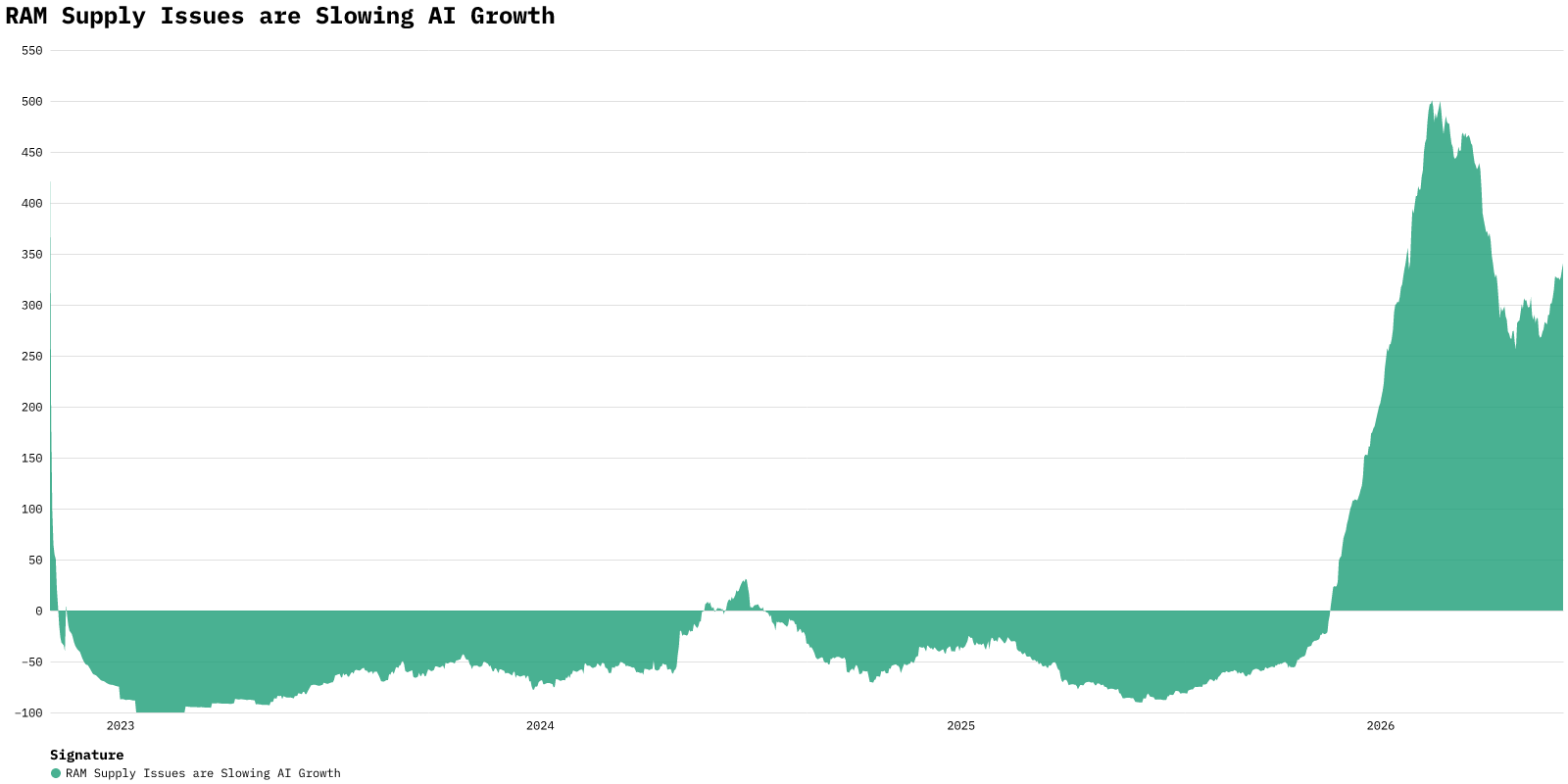
The media conversation around what is actually constraining AI growth has shifted in a measurable way. Three of Perscient's four infrastructure-constraint semantic signatures strengthened this week, all three occupying some of the highest absolute levels in the full dataset. Our signature tracking the density of language asserting that unexpected shortages in memory chips are slowing AI growth registered at 340.8, up by 13.0 points. The signature tracking language asserting that slow approvals and completion of power grid interconnects are slowing AI growth reached 153.3, up by 12.3 points. And the signature tracking language asserting that unexpected delays in data center construction and completion are slowing AI growth climbed to 112.8, up by 11.3 points.
The outlier is telling. Our signature tracking language asserting that unexpected shortages in high-powered GPUs are slowing AI growth declined by 6.0 points to 10.8. The bottleneck frame in media coverage has rotated decisively: the binding constraints on AI are no longer about whether we can fabricate enough chips but whether we can power, cool, connect, and house the systems those chips go into.
The memory story is structural and deepening. Research from SemiAnalysis, cited by Data Center Knowledge, estimates that memory could account for roughly 30% of hyperscaler AI spending in 2026, up from about 8% in 2023 and 2024. High-bandwidth memory and DRAM have become the tightest pressure points; AI now consumes most of the world's DRAM production capacity. Samsung, SK Hynix, and Micron have reallocated production toward the high-bandwidth memory used in AI accelerators, which generates three to five times higher margins than conventional consumer DRAM. According to a weekly market intelligence report from 1Buy, DRAM prices hit a record high of $62.7, and contract prices rose by 60% in Q1 2026; 70% of memory production is now allocated to AI infrastructure. Intel CEO Lip-Bu Tan's assessment that there will likely be "no relief until 2028" has become a widely cited reference point, and Motley Fool analysis reinforced the view that this tightness is structural rather than cyclical, since HBM requires three times the wafer capacity of conventional memory chips.
 Source: Perscient
The interconnect and data center delay story is equally acute. Against a 16 GW announced 2026 pipeline, only about 5 GW is actually under construction. Goldman Sachs Commodities Research projects that U.S. data center power demand will more than double to 66 GW in 2027 from 31 GW in 2025, but notes that only 50-60% of data center capacity scheduled for the next one to two years is expected to come online on time. A Facebook post from The Science Pulse highlighted that almost half of the U.S. data centers expected to come online in 2026 have been pushed back or canceled. The main pressure points are power access, grid connection delays, construction bottlenecks, and local opposition. Bessemer Venture Partners' data center stack roadmap put the problem in sharp relief: data centers can be constructed within 12 to 18 months, but connecting them to the grid currently takes five to seven years. Transformer demand has increased by 119% from 2019 to 2025, but manufacturing capacity has not kept pace, and lead times have stretched to five years.
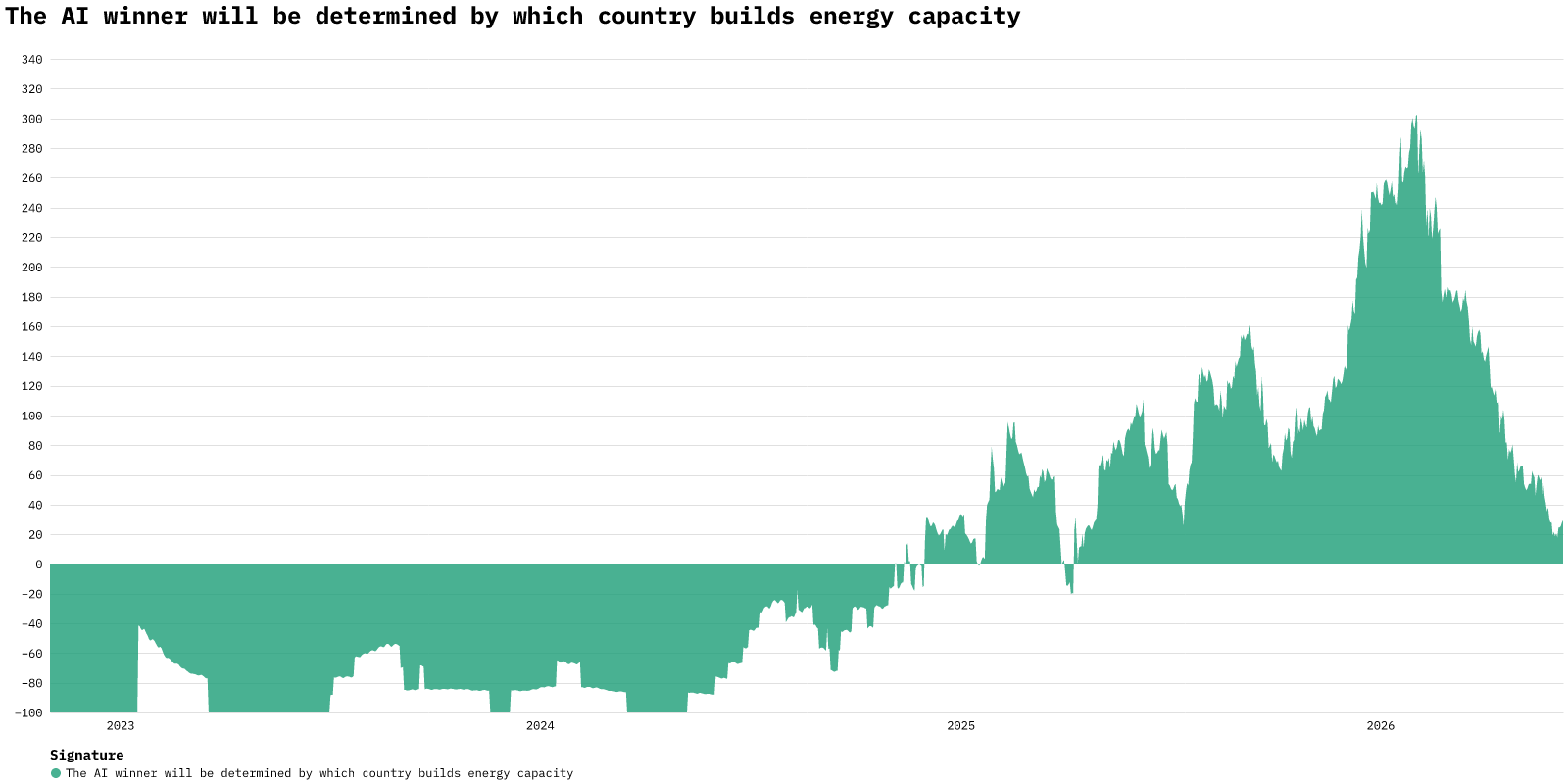
Perscient's semantic signature tracking language asserting that the country which can build the best energy infrastructure will determine AI leadership strengthened by 10.9 points to 29.5, the fifth-largest weekly increase across all signatures. RAND estimates AI data centers could require 68 GW of power globally by 2027, and Anthropic has projected that the U.S. AI sector alone will need 50 GW of new electric capacity by 2028 to maintain global leadership. The media's framing of AI constraints has migrated from chip availability to the surrounding physical infrastructure, and the simultaneous rise of memory, interconnect, data center, and energy-capacity narratives marks a meaningful shift in how AI growth limitations are discussed.
 Source: Perscient
Anthropic's IPO and Model Leadership Consolidate a Lopsided Competitive Narrative
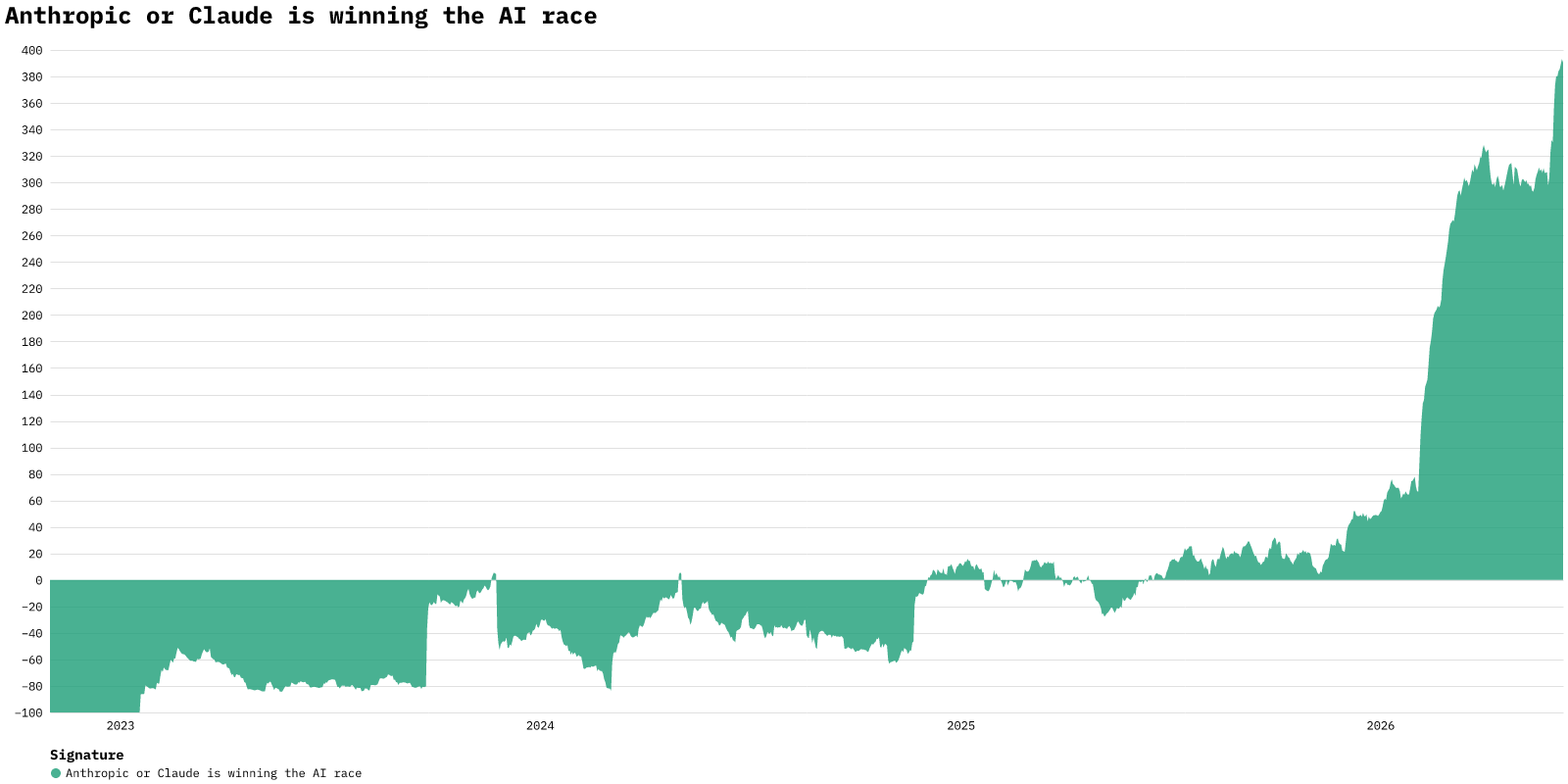
Competition among AI companies is being narrated through an increasingly narrow lens. Perscient's semantic signature tracking language asserting that Anthropic or Claude leads the artificial intelligence competition holds the highest absolute value in the full dataset at 390.5 and strengthened by 17.3 points this week, the second-largest one-week increase of any signature.
The week's primary catalyst was Anthropic's confidential IPO filing with the SEC. As Reuters reported, the filing edges Anthropic ahead of OpenAI in the race to public markets, and the New York Times noted that Anthropic is expected to be among three high-profile companies preparing to go public this year, alongside SpaceX and OpenAI. The company's most recent private funding round valued it at approximately $965 billion, surpassing OpenAI's reported valuation of $852 billion. TechCrunch confirmed the confidential filing, and the breadth of coverage across major outlets amplified the frontrunner narrative.
 Source: Perscient
Anthropic generated additional coverage through its June 4 blog post urging a coordinated global pause in frontier AI development. Anadolu Agency reported that the company called for international coordination, warning that society may struggle to keep pace with rapidly advancing AI systems. The urgency was underscored by Anthropic's own disclosures: Claude models now autonomously write approximately 80% of the company's code, and Claude Mythos Preview achieved a 52x speedup over baseline code on optimization tasks, bringing the system closer to what some describe as recursive self-improvement. Leaked reports of a forthcoming Claude Mythos public release added further fuel, and TechnoSports noted that if rumored pricing holds, the release would put serious pressure on every competitor in the premium AI segment.
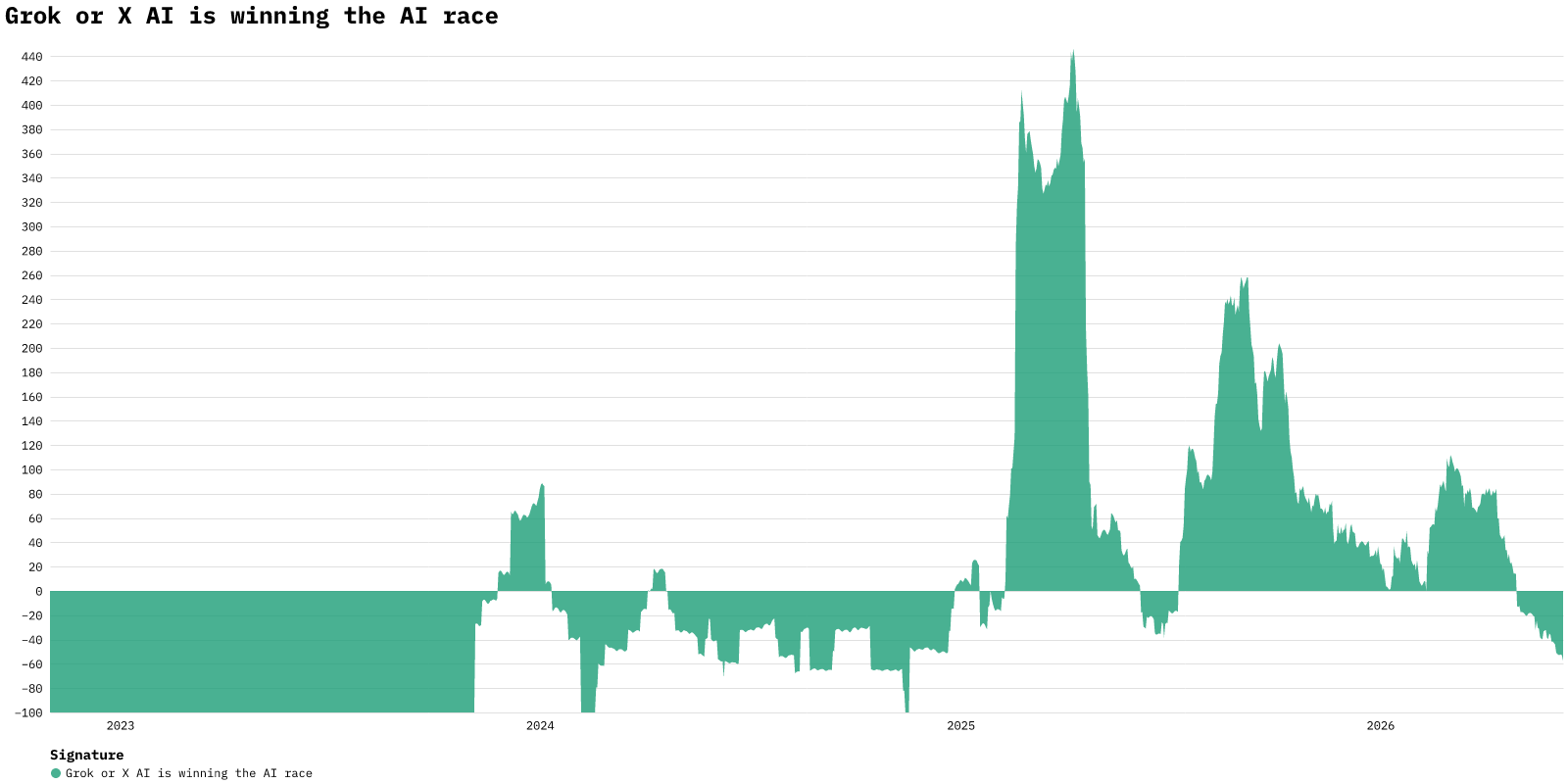
The contrast with other AI competitors is stark. Our signature tracking language asserting that Grok or xAI leads the artificial intelligence competition declined by 13.6 points to negative 57.7, the single largest one-week decline across all signatures. Downloads of the Grok app fell by nearly 60% from their January peak to around 8.3 million in April, according to ALM Corp analysis. Elon Musk's xAI has paused hiring for specialists to train its Grok chatbot, per Bloomberg, and amid reports of several top engineers departing, Musk himself admitted that xAI "was not built right first time around."
 Source: Perscient
Our signature tracking language asserting that OpenAI leads the competition remained flat at negative 47.3, well below its long-term average, while the Google/Gemini signature held steady at 23.6, the only other competitor signature above its mean. The Deepseek/China signature stayed flat at negative 34.3, suggesting that the China competitive-threat narrative has receded considerably since early 2025. The competitive picture is strikingly lopsided: Anthropic at 390.5, Google at 23.6, and every other competitor below average.
Emerging signals suggest that the narrative may contain internal tensions. WhyTryAI observed that an initial burst of goodwill is not always enough to compensate for uptime issues, poor PR decisions, and subpar product launches, pointing to friction between Anthropic's market positioning and the operational pressures of scaling.
Capex Conviction and Bubble Anxiety Rise Together, Defining a Tense Capital Narrative
The infrastructure bottlenecks and competitive dynamics described above converge on a single question: is the capital being committed to AI justified by the returns it will eventually generate? This week, the media's answer was both yes and no.
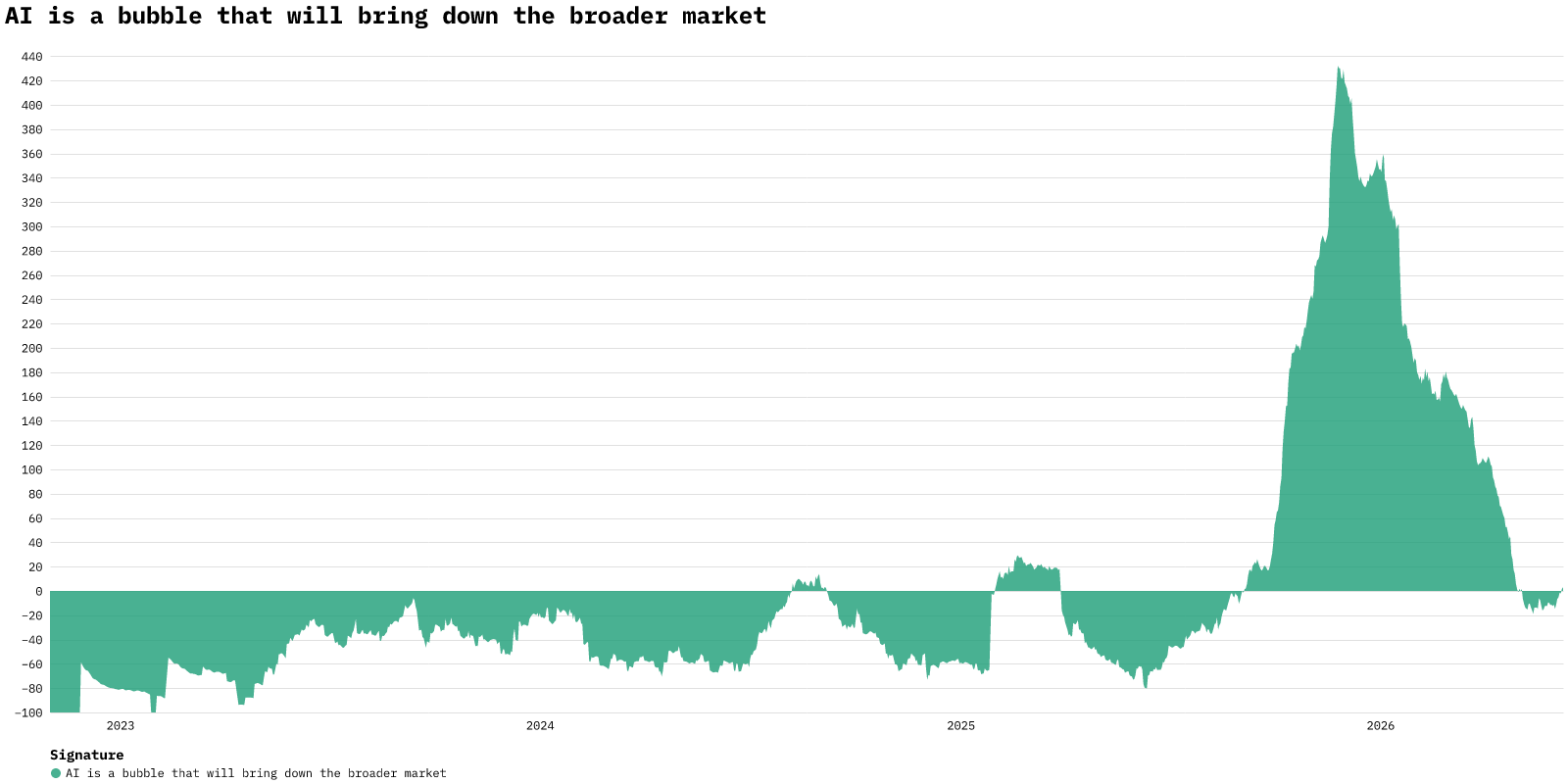
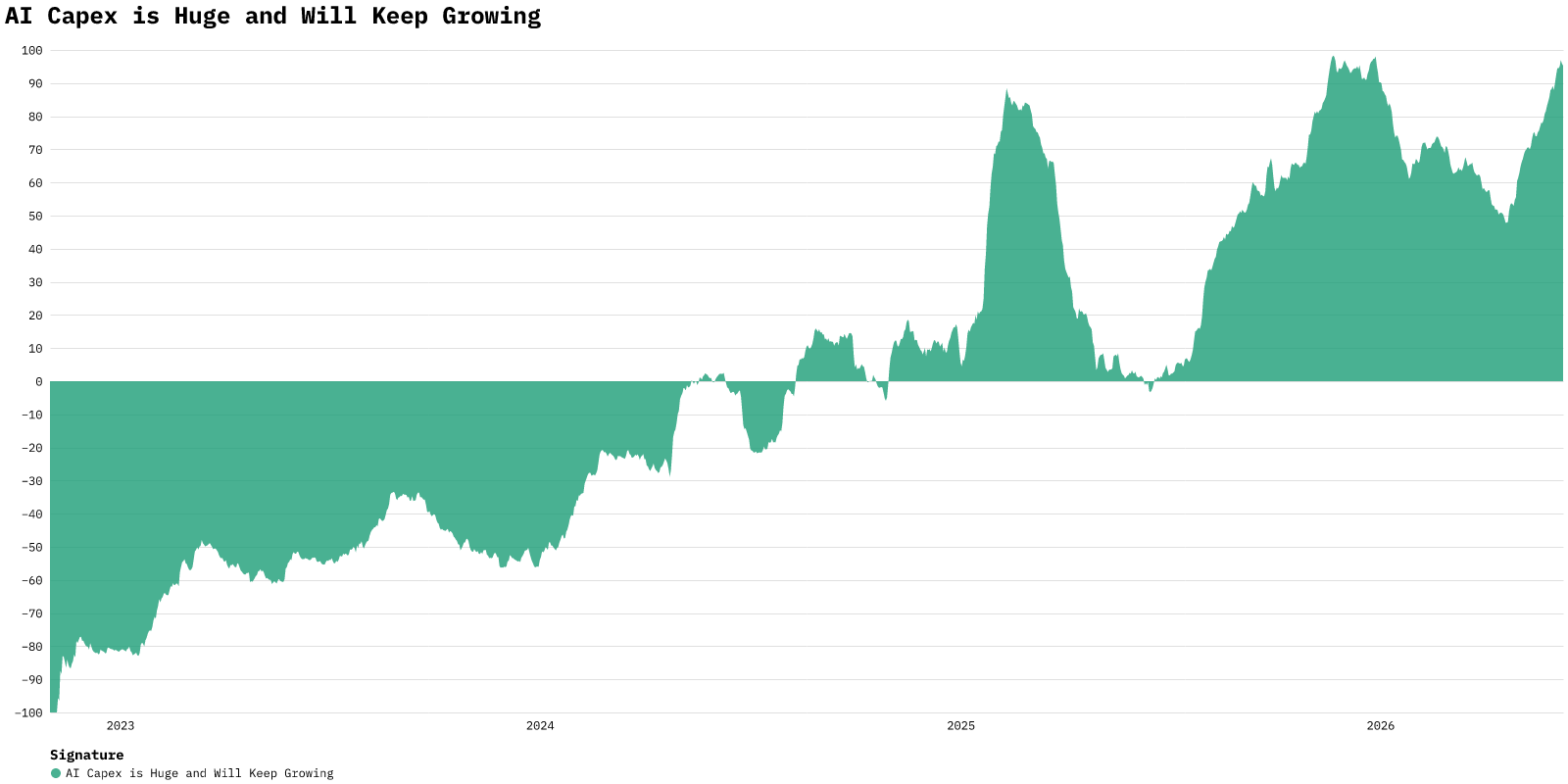
Perscient's semantic signature tracking language predicting that an AI investment collapse will crash overall markets recorded the single largest one-week change of any signature in the dataset, rising by 17.9 points from negative 14.8 to 3.1, returning the bubble narrative to approximately its long-term average after a sustained period below it. Simultaneously, our signature tracking language asserting that AI infrastructure spending is massive and increasing strengthened to 95.3, up by 5.2 points, while the signature tracking language predicting that AI creates a long-term investment supercycle remained well above average at 76.8. These narratives are rising in tandem rather than trading off against one another.
 Source: Perscient
The capex figures underpin the enthusiasm. Bloomberg reported that Alphabet, Meta, Microsoft, and Amazon are expected to rack up combined capital expenditures of more than $500 billion this year. Alphabet alone upsized its equity raise to $84.8 billion from the $80 billion it announced just two days earlier. Goldman Sachs' baseline model implies $765 billion in annual AI capex in 2026; cumulative spending between 2026 and 2031 is projected at roughly $7.6 trillion. As Investopedia noted, BCA Research analysts observed that Alphabet's equity funding suggests that the AI capex cycle is entering an increasingly mature and capital-intensive phase, where even cash-rich hyperscalers are tapping external capital.
The skepticism cluster is strengthening alongside the spending enthusiasm. Our signature tracking language claiming that opposition to large AI investments is increasing rose by 7.7 points to 76.9, while the signature tracking language asserting that businesses increasingly doubt large AI spending increased by 5.8 to 39.5. Fortune reported that one prominent analyst, a self-described member of the "AI is a bubble" camp, argued that a significant share of the "record revenue" reported by frontier model companies is coming from other AI companies. Critics highlight circular capital flows in which AI companies receive investment capital, immediately spend it on compute from cloud hyperscalers, which counts as "revenue" for the hyperscalers, raising their valuations and supporting continued AI investment. An NBER study published in February 2026 found that 90% of firms reported no impact of AI on workplace productivity.
 Source: Perscient
The bull case is not silent. Wells Fargo described the AI trade as a "euphoric" bubble and recommended that clients buy into it, arguing that the sheer volume of capex is too large to ignore and that the spending companies are among the most profitable businesses in history, unlike the pre-revenue dot-com startups. However, even within the optimistic camp, some conviction is fraying. Our signature tracking language asserting that the AI investment theme remains durable moderated by 5.3 points to 40.8, one of the larger weekly declines among above-average signatures. The signature tracking language asserting that businesses must adopt AI or fail competitively also declined by 3.6 to 12.4.
The net result is a media environment in which the AI capital cycle is described as both immense and potentially fragile. The signatures tracking capex enthusiasm and bubble anxiety do not usually strengthen together. Their joint rise this week signals a media conversation that is simultaneously bullish and anxious, a tension that warrants close attention, particularly because the gap between announced investment and realized returns continues to widen.
