EXECUTIVE SUMMARY
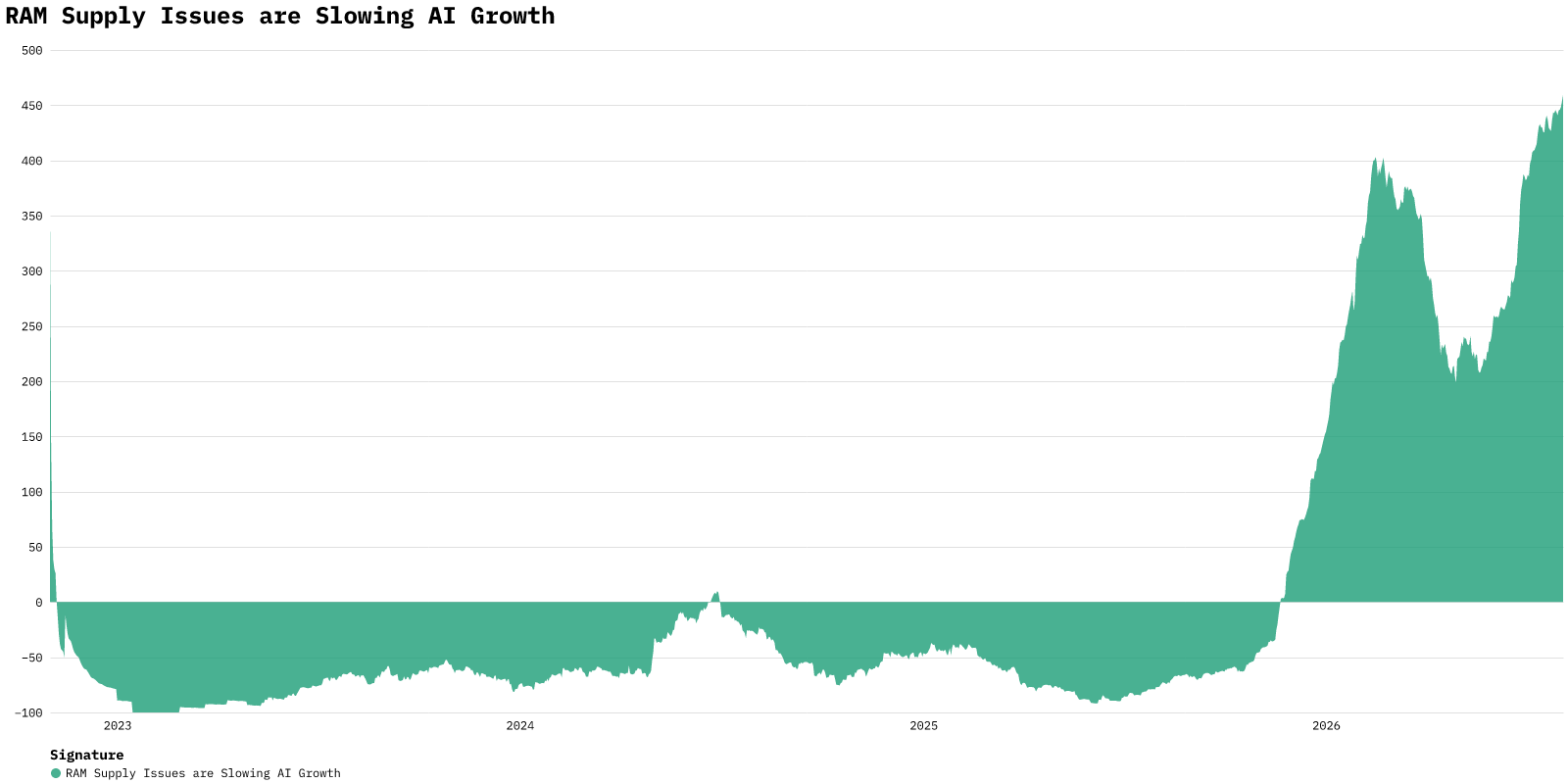
- The bottleneck story has been rewritten around memory and physical infrastructure rather than accelerators. Coverage asserting that memory-chip shortages are throttling AI growth was the densest and fastest-rising signature we track this week, while the equivalent GPU-scarcity framing sat flat at its long-term norm. Reporting on Samsung, SK Hynix, and Stargate-scale demand pushed the constraint narrative toward DRAM allocation, transformer lead times measured in years, and interconnection queues, which recasts AI capacity as a supply-chain and permitting problem instead of a chip-design problem.
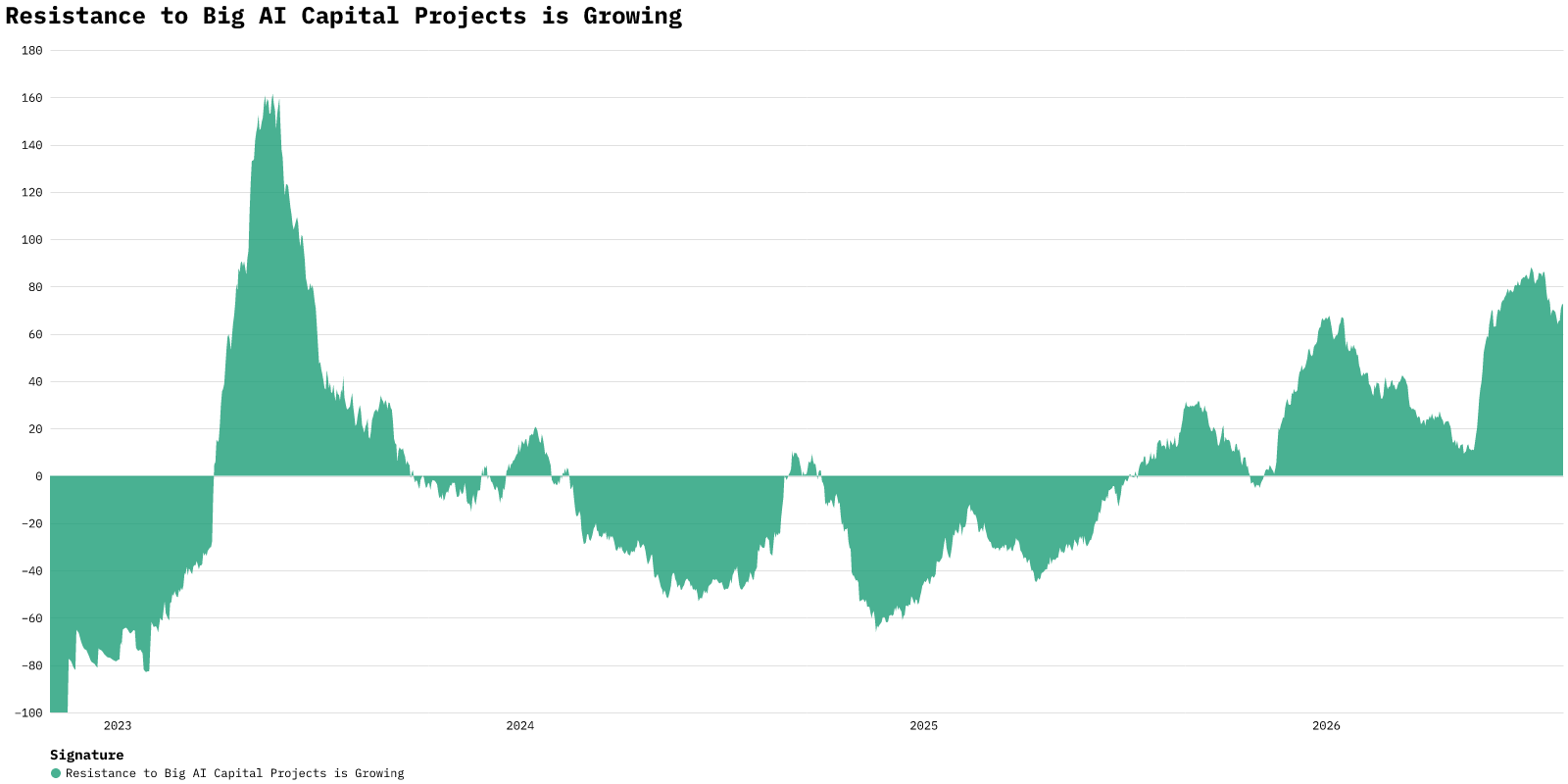
- Local resistance has become a durable narrative thread, not an episodic one. Density of language claiming that opposition to large AI capital projects is growing continued climbing, anchored in moratorium counts, polling showing that neighborhood opposition has risen sharply since January, and tallies of blocked projects. Notably, one contrarian counterweight appeared in the coverage set, arguing that cancellation figures are inflated because most flagged capacity was never past the announcement stage.
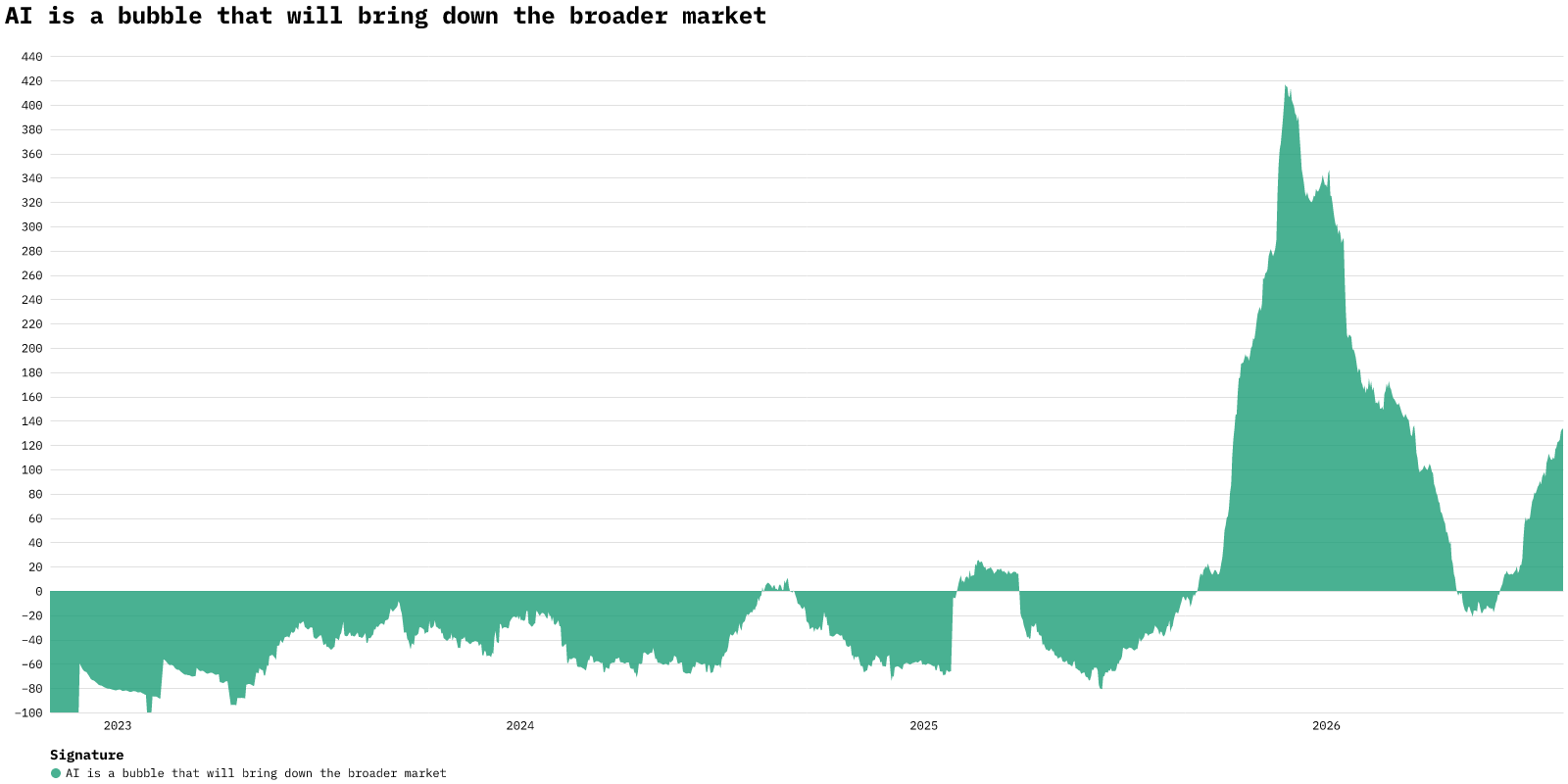
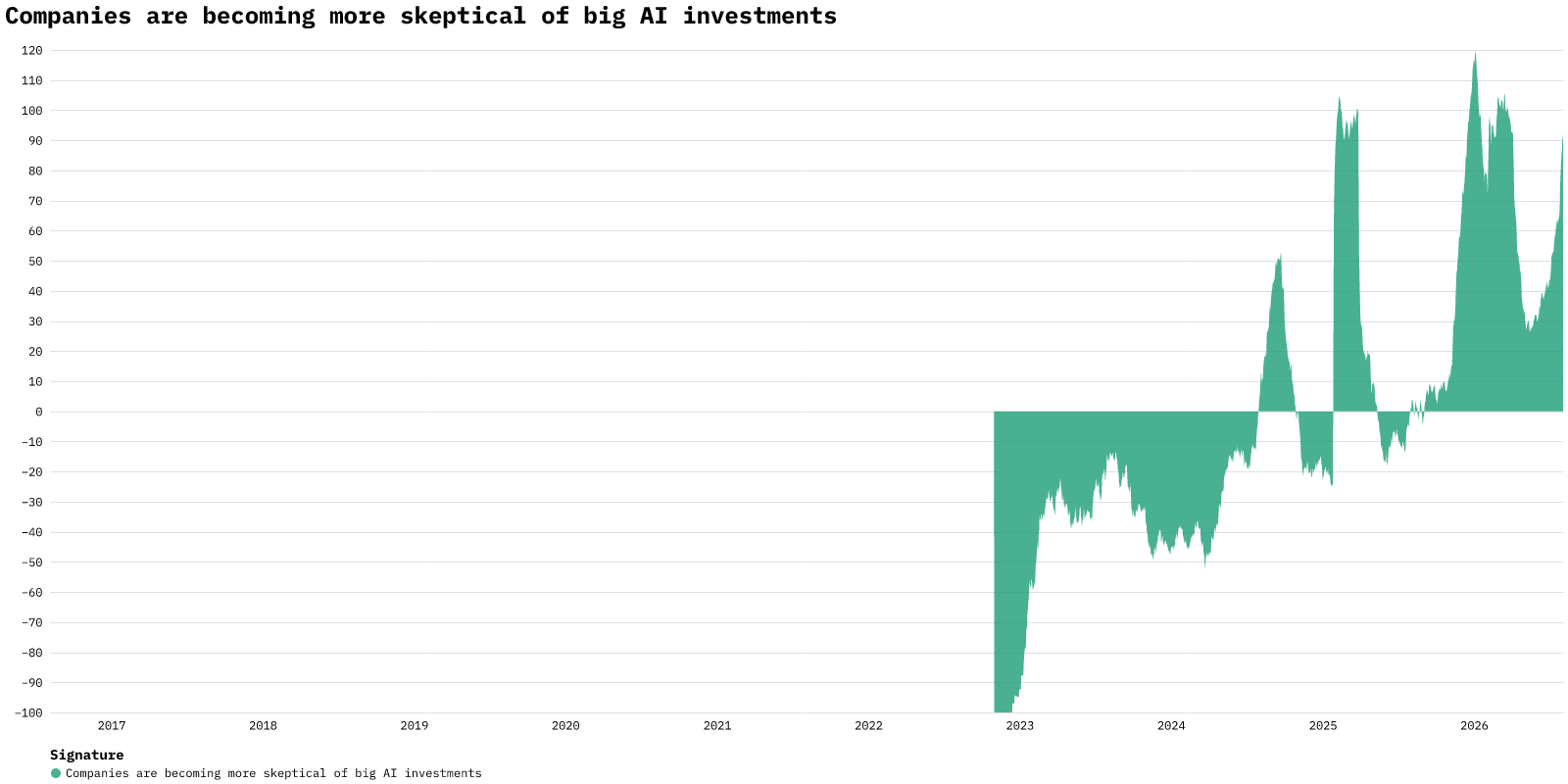
- Skepticism is being expressed in the vocabulary of financial risk rather than technological letdown. Signatures tracking predictions of an AI-investment collapse spilling into the broader market and language asserting that businesses doubt their own AI spending both jumped sharply, yet the classic disillusionment framings — hype giving way to disappointment, the dot-com fiber analogy, missing efficiency gains — stayed subdued or negative. Media are conceding the spending and disputing the payoff, with financing structure, off-balance-sheet commitments, and the distinction between a valuation bubble and an earnings bubble carrying the argument.
- Expansion and doubt are now reported simultaneously rather than in sequence. Language describing massive and rising AI infrastructure spending barely eased and predictions of continued hyperscale expansion held flat, even alongside the surge in collapse framing. Meanwhile, the competitive-urgency argument that non-adopters will be left behind stayed flat, meaning outlets are not deploying fear of falling behind to blunt buyer skepticism.
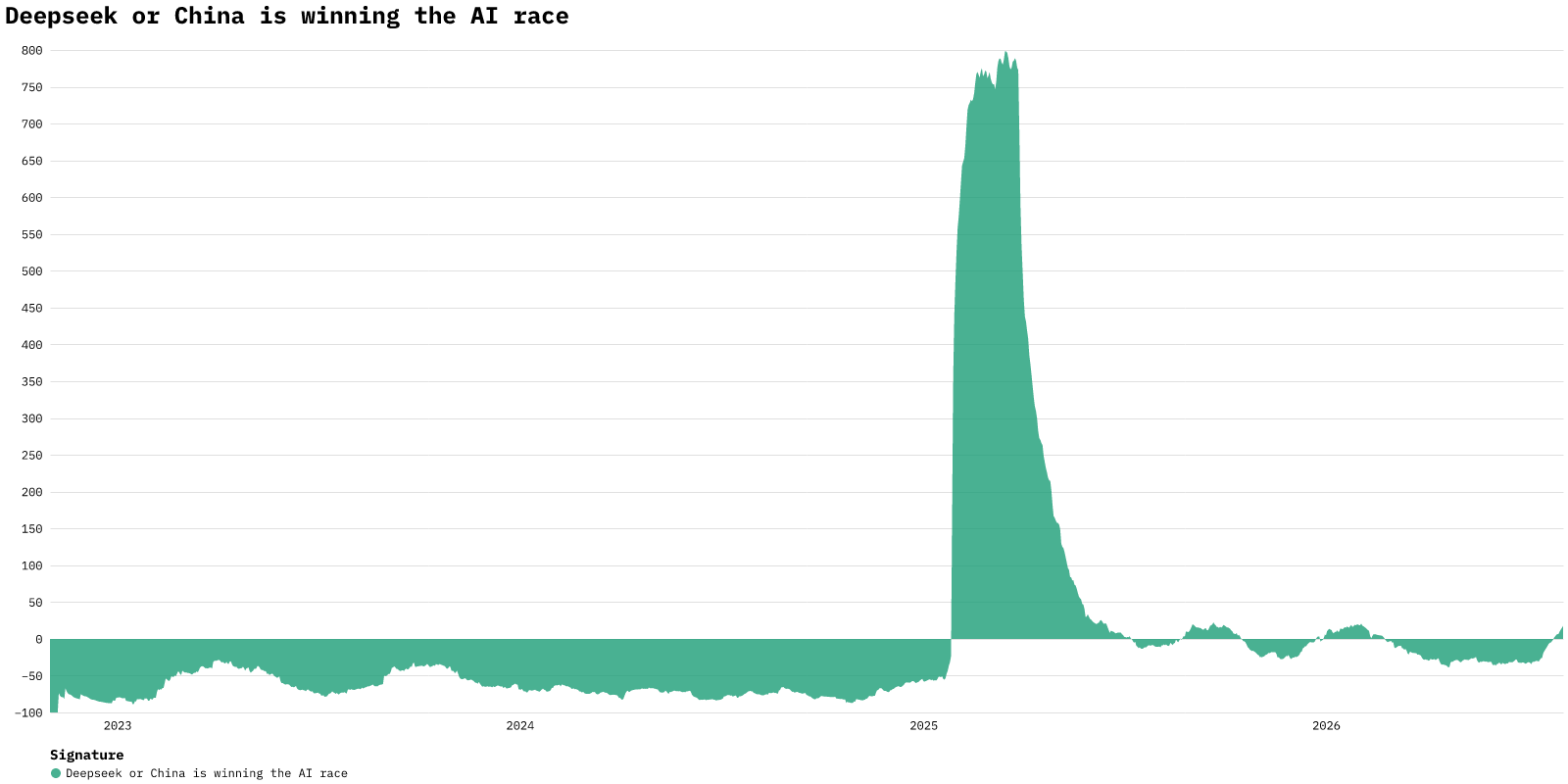
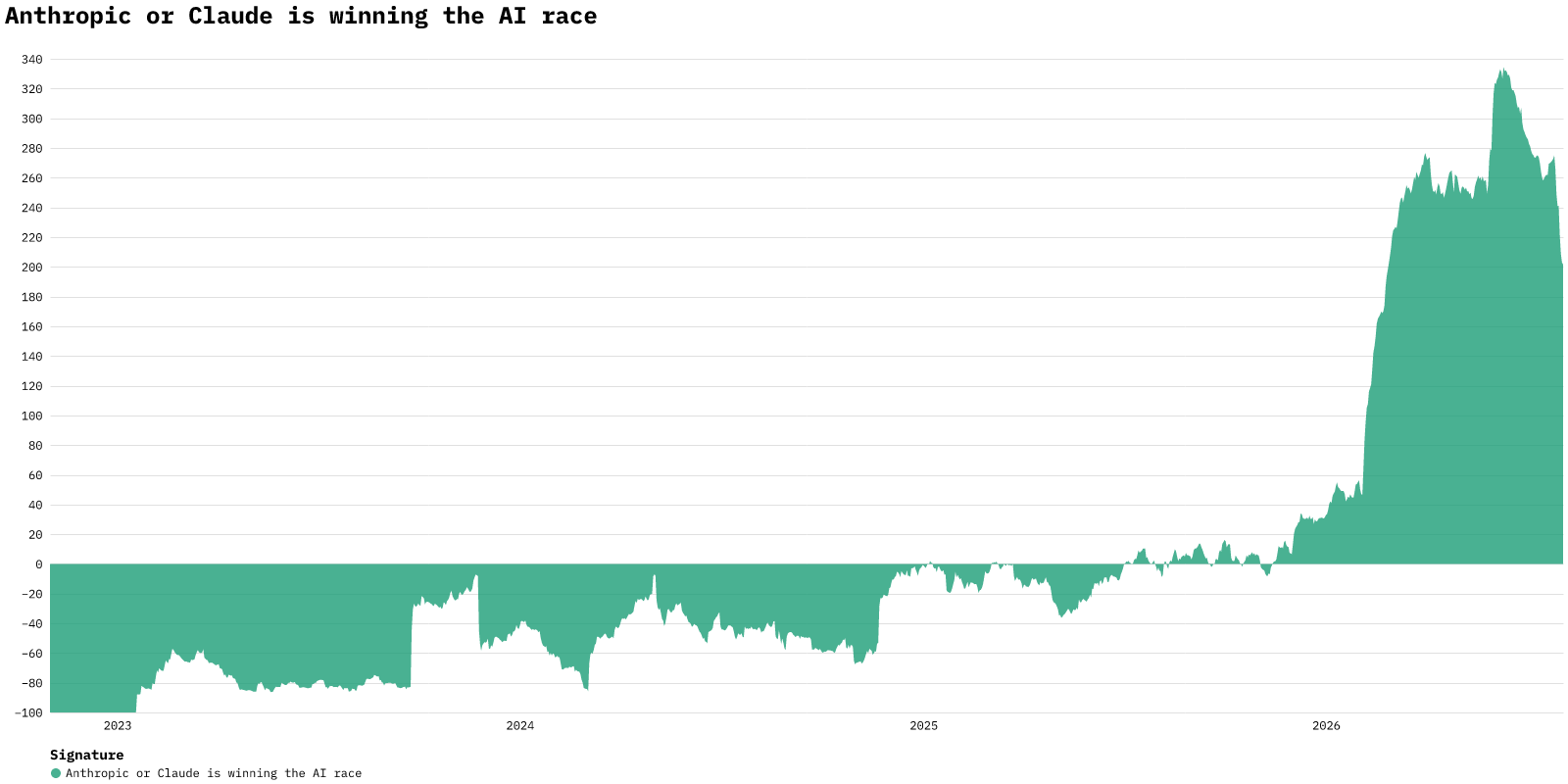
- Competitive coverage fragmented around price per token instead of benchmark supremacy. Density of Anthropic-leads language fell steeply from a very high base while OpenAI and Google leadership framings weakened further, and the DeepSeek-or-China signature posted the group's sharpest gain following the V4-Flash release, with xAI also registering its first meaningful move above norm. Because this price war surfaced in the same week that buyer-skepticism density peaked, falling unit costs read as procurement leverage arriving exactly when AI budgets face the most scrutiny — a convergence likely to fuse the competitive and capital-markets storylines as Anthropic's listing window approaches.
Memory Shortages, Market-Risk Framing, and a Widening Model Price War Set the Week's AI Agenda
The Constraint Story Has Moved From Chips to Memory, Substations, and Zoning Boards
Perscient's semantic signature tracking the density of language asserting that memory-chip shortages are slowing AI growth stands at 459.4 this week, up by 13.7, the strongest reading across every signature we track. Our signature tracking language asserting that GPU shortages are slowing AI growth reads just 4.4, essentially at its long-term norm and flat on the week. Media coverage of what constrains AI has moved almost entirely from accelerators to DRAM and high-bandwidth memory. Bloomberg reported that SK Hynix's CEO expects the memory crunch to persist beyond 2030; DRAM spot prices are up by nearly 700% over the past year, and memory is now roughly 35% of laptop material costs according to HP (https://tech-insider.org/memory-chip-shortage-2026-ai-consumer-electronics/). Analysts estimate that AI data centers could consume roughly 70% of high-end DRAM in 2026, and relief is unlikely before 2027 because new capacity lags demand (https://www.avnet.com/integrated/resources/article/2026-memory-shortage-ai-supercycle/). Samsung, which supplies about a third of the world's memory, told investors on its Q2 call that the shortage will likely intensify in 2027 and persist until at least 2028; frontier labs now share medium- and long-term demand forecasts directly with the company to lock in allocation (https://techcrunch.com/2026/07/31/samsung-expects-memory-shortage-to-worsen-through-2027-and-last-until-2028/). NPR reported that OpenAI's Stargate initiative alone may require an amount of memory equal to 40% of world supply (https://www.npr.org/2026/07/30/nx-s1-5909318/massive-demand-from-ai-data-centers-drives-up-computer-memory-prices).
 Source: Perscient
Our signature tracking language asserting that data center build delays are slowing AI growth rose by 21.3 to 170.8, the largest one-week increase of any signature this period. Meanwhile the companion signature tracking claims that slow grid interconnection approvals are slowing AI growth eased somewhat but remains among the most elevated readings in the set. PJM figures show that AI infrastructure projects entering service in 2025 took an average of more than seven years end to end, and substation transformer lead times now exceed 160 weeks (https://www.datacenterknowledge.com/energy-power-supply/why-ai-data-center-projects-face-years-of-delays-after-approval). SemiAnalysis argues that widely cited cancellation and delay figures overstate the problem, since almost all flagged capacity sits in the early-stage "announced" bucket (https://newsletter.semianalysis.com/p/stop-saying-half-of-2026-us-datacenter).
Our signature tracking language claiming that opposition to large AI capital projects is increasing rose by 3.6 to 72.7, continuing its climb. Half of Maryland jurisdictions have imposed a moratorium over electric rates, noise, and water use, and a July Politico poll found that 41% of Americans would oppose a data center within three miles of home, up from 28% in January, with opposition spanning party lines (https://technical.ly/civics/maryland-activists-press-annapolis-for-data-center-pause/). Backlash delayed or blocked at least 75 projects worth a cumulative $130 billion in Q1 2026 alone (https://debatearguments.substack.com/p/data-center-moratorium-or-ban-what), and Brookings counts at least 15 states weighing pauses and more than 100 localities that have already approved them; New York became the first state to impose a moratorium by executive order. Our signature tracking claims that national energy-buildout capacity will determine the AI winner was flat, and our signature tracking claims that training data scarcity is slowing AI growth was likewise unchanged.
 Source: Perscient
Doubt Is Being Priced as Market Risk, Not as Technology Disappointment
Our signature tracking language predicting that an AI investment collapse will crash the broader market rose by 17.3 to 133.8, the strongest reading among the market-framing signatures and the second-largest weekly increase in the set. Our signature tracking language asserting that businesses increasingly doubt large AI spending rose by 16.8 to 92.1. Doubt is being voiced at both the index level and the purchase-order level at once, with reinforcing gains in our signatures tracking characterizations of AI capex as a dangerous gamble and doubts about hyperscale projects.
 Source: Perscient
Ray Dalio warned that AI enthusiasm has pushed markets into territory echoing 1929 and 2000, endorsing Jeremy Grantham's characterization of a "bubble within a bubble," while Goldman Sachs argued on August 3 that there does not appear to be a valuation bubble but there may be an earnings bubble (https://en.cryptonomist.ch/2026/08/04/ray-dalio-ai-bubble/). Goldman's framing shifts the risk to the durability of earnings growth itself (https://www.investing.com/news/stock-market-news/goldman-the-real-ai-risk-is-an-earnings-bubble-not-valuations-4830442), a distinction Jim Covello sharpened by estimating that the world will have spent north of $3 trillion on AI by end of 2026 against "very disappointing" enterprise adoption (https://x.com/henrikhinai/status/2081394034711417286). Anthropic has confidentially filed for a listing expected as early as October at a valuation near $1 trillion, while OpenAI's separately filed debut has slipped from late 2026 toward 2027.
The spending narrative has not broken. Our signature tracking language asserting that AI infrastructure spending is massive and increasing eased by only 3.4 to 67.9, and the companion signature tracking predictions of continued hyperscale expansion held flat. Expansion and doubt are now being reported side by side rather than sequentially. CreditSights now projects roughly $750 billion in 2026 capex for the top five hyperscalers, up from about $620 billion estimated in January, implying a third consecutive year of growth above 60% (https://know.creditsights.com/insights/tech-raising-hyperscaler-capex-2026-estimates/). J.P. Morgan Asset Management notes that AI capex has gone from 33% of hyperscalers' cash flow from operations in 2023 to an estimated 93% in 2026 (https://am.jpmorgan.com/dk/en/asset-management/institutional/insights/market-insights/investment-outlook/technology-and-ai/), which explains why financing structure is becoming the bears' preferred terrain; critics like Ed Zitron point to over $300 billion in debt and more than $1.4 trillion of off-balance-sheet commitments (https://x.com/edzitron/status/2082155114001748326).
This is not a disillusionment cycle in the classic sense. Our signature tracking claims that AI hype is giving way to a disappointment phase remains subdued at -17.9, and the dot-com fiber analogy signature was flat. Our signature tracking assertions that promised AI efficiency gains have not occurred held steady, while the signature tracking claims that AI advances are translating into company profits fell further into negative territory. A survey of 639 senior enterprise AI leaders found that the share whose ROI has failed to outpace investment stuck at 57% since 2025, even as 93% reported improved production capabilities (https://www.telecomreviewamericas.com/articles/reports-and-coverage/enterprise-ai-hits-a-reality-check-57-still-failing-to-outpace-investment-returns/). The Federal Reserve's July 17 note cautions that the absence of an aggregate productivity signal in 2026 would not invalidate future impacts, since measured gains from general-purpose technologies historically lag investment by years. Coverage, in short, is granting the spending but not the payoff. Time horizons are compressing too, and our supercycle signature fell further negative, yet the signature tracking assertions that the AI investment theme remains durable was unchanged. Our signature tracking claims that companies not investing in AI will be left behind was flat, meaning the competitive-urgency argument is not being deployed to offset buyer skepticism.
 Source: Perscient
The Leaderboard Fragments as a Token Price War Reshapes Competitive Coverage
The competitive story this week is fundamentally about price. Our signature tracking language asserting that Anthropic or Claude leads the AI race remains the strongest of the competitive signatures at 201.7, but it declined by 64.4 from 266.1. Our signatures tracking claims of OpenAI leadership and Google or Gemini leadership both weakened further into negative territory.
The rotation went east instead. Our signature tracking language asserting that DeepSeek or China leads the AI race rose by 13.9 to 17.7, the sharpest move in the competitive group, from a near-neutral prior reading. The proximate driver was DeepSeek's official release of V4-Flash on July 31, arriving behind its mid-July target and without the anticipated V4-Pro, but with enhanced autonomous agent capabilities and further reduced API costs (https://www.caixinglobal.com/2026-08-01/deepseek-releases-official-v4-flash-model-as-chinas-ai-race-intensifies-102470292.html). Pricing, not capability, is now the story. V4-Flash performs close to Anthropic's Claude Opus 4.8 on complex coding and autonomous software tasks at roughly 28 cents versus $25 for the same output, and July brought a full-scale price war: OpenAI cut GPT-5.6 Luna by 80% three weeks after launch, Google released three efficiency-focused Gemini flash models, and Grok 4.5 shipped (https://www.axios.com/2026/08/01/deepseek-model-cheap-ai-price-war). Semafor frames DeepSeek's move as a share grab, with a 50% token cost cut and a pause on planned peak-hour variable pricing, even as Beijing warns tech firms against "involution" and even as V4-Flash still trails Moonshot's Kimi K3 on benchmarks (https://www.semafor.com/article/08/03/2026/deepseek-releases-cut-price-new-ai-model-as-chinas-price-war-intensifies). At one moment in mid-July, six of the top ten models on developer usage rankings, and all of the top five, came from Chinese companies, and Meituan claimed that its LongCat-2.0 was trained entirely on Chinese-made processors (https://fortune.com/2026/07/26/china-moonshot-deepseek-zai-kimi-challenging-us-ai-cost/).
 Source: Perscient
Our signature tracking claims that Grok or xAI leads the AI race rose to 13.7 from 4.5, its first meaningful move above its long-term norm. The Grok 4.5 release, now rolling out in GitHub Copilot for agentic coding workflows (https://github.blog/changelog/2026-07-28-grok-4-5-is-now-available-in-github-copilot/), is the likely proximate cause. Our signature tracking claims that the eventual AI winner has not been founded yet ticked up from near zero, aligned with coverage arguing the lead can now change by task, release cycle, or pricing model.
Anthropic's elevated position continues to rest on enterprise distribution rather than benchmark headlines. Cognizant expanded its partnership with Anthropic on July 27 to embed Claude across its platforms and scale a Claude-certified workforce (https://www.anthropic.com/news/cognizant-anthropic), and Claude Sonnet 5 carries introductory pricing of $2 per million input tokens and $10 per million output tokens through August 31. This price war lands in the same week that our buyer-skepticism signature reached 92.1. Falling unit costs strengthen procurement leverage precisely when scrutiny of AI budgets is rising. Our signatures tracking predictions that AI will kill internet search and kill news organizations sit deeply negative, so displacement framing is largely absent. The competitive story this week is agents, cost per token, and open weights, and with Anthropic's October listing window approaching, expect competitive standing and the capital-markets narrative from Section 2 to fuse into a single storyline this autumn.
 Source: Perscient
