EXECUTIVE SUMMARY
- Crash language and capex conviction rose together, and neither displaced the other. Media coverage this week paired warnings of a 1929- or 2000-style unwind with bullish index targets and reporting that capex angst is fading. What did not accompany the crash framing was the usual disillusionment story: language claiming that hype is giving way to disappointment fell, and claims that AI occupies an excessive share of market valuation slipped. Commentators are arguing systemic market risk directly rather than routing it through a "the technology underdelivered" narrative.
- The payoff story remains the missing piece, and its absence keeps both camps in circulation. Coverage asserting that efficiency gains have not materialized held steady, while language tying AI advances to company profits stayed near its long-run baseline. The long-duration arguments — supercycle framing, efficiency-and-UBI framing — weakened, which means near-term spending conviction is being asserted without the multi-year justification that would normally sit beneath it.
- The binding constraint in media coverage has moved off the accelerator and onto memory, sites, and power. Language asserting that memory shortages are throttling AI growth is by far the most prominent constraint frame in the file, while GPU-scarcity language has receded to background levels. Data center construction delays rank second, grid interconnection language moderated from a very high base, and local opposition coverage held firm around moratoriums, county bans, and congressional proposals for community veto power.
- These physical bottlenecks supply the most concrete mechanical support for the hyperscale doubts tracked in the financial coverage. The bear case circulating this week is less about demand evaporating and more about DRAM sold out through 2027, five-year interconnection queues, and capacity prices rising by an order of magnitude — a supply-side and cost-side skepticism rather than a demand-side one, which explains why crash talk can rise even while disillusionment language falls.
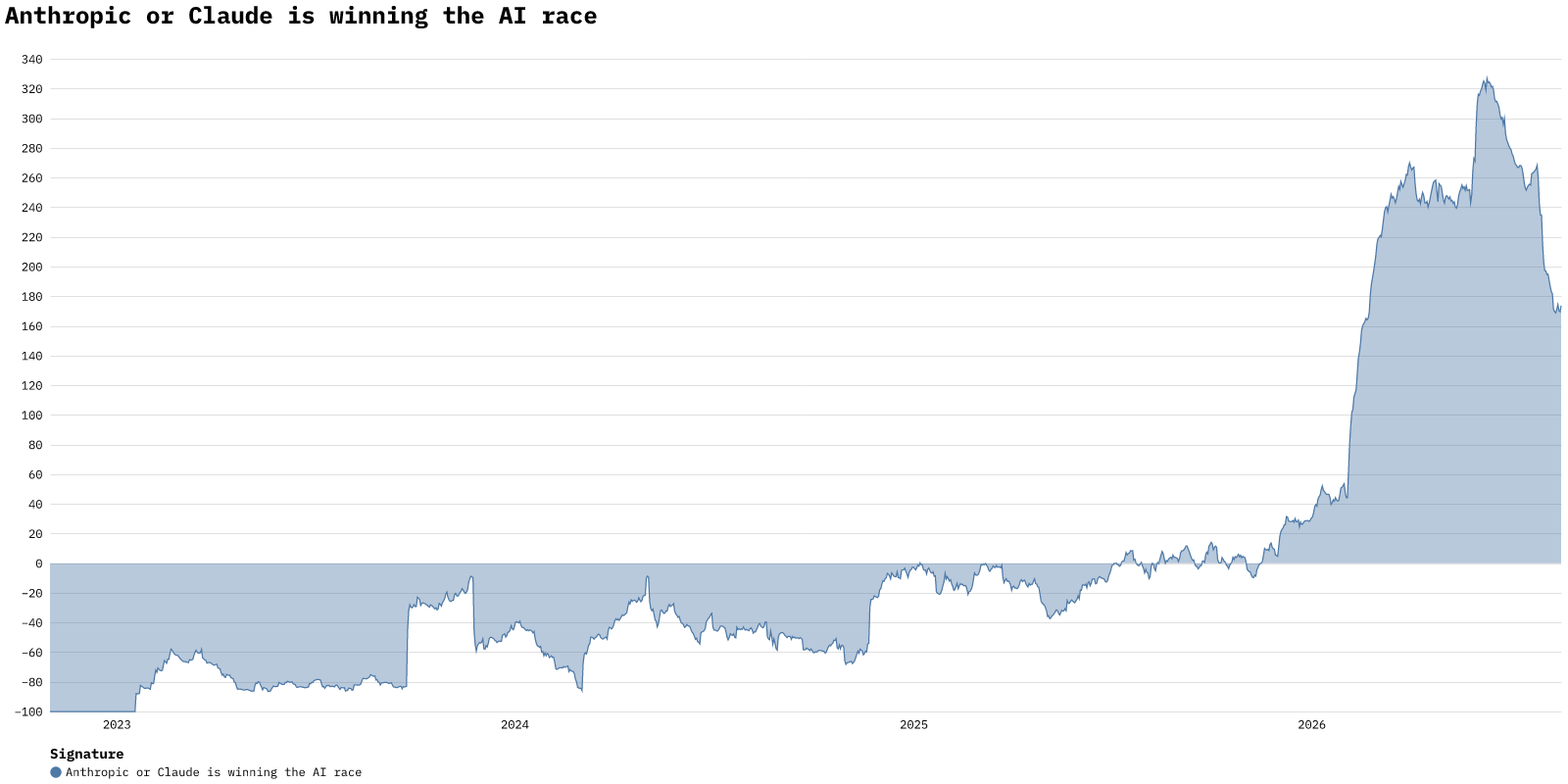
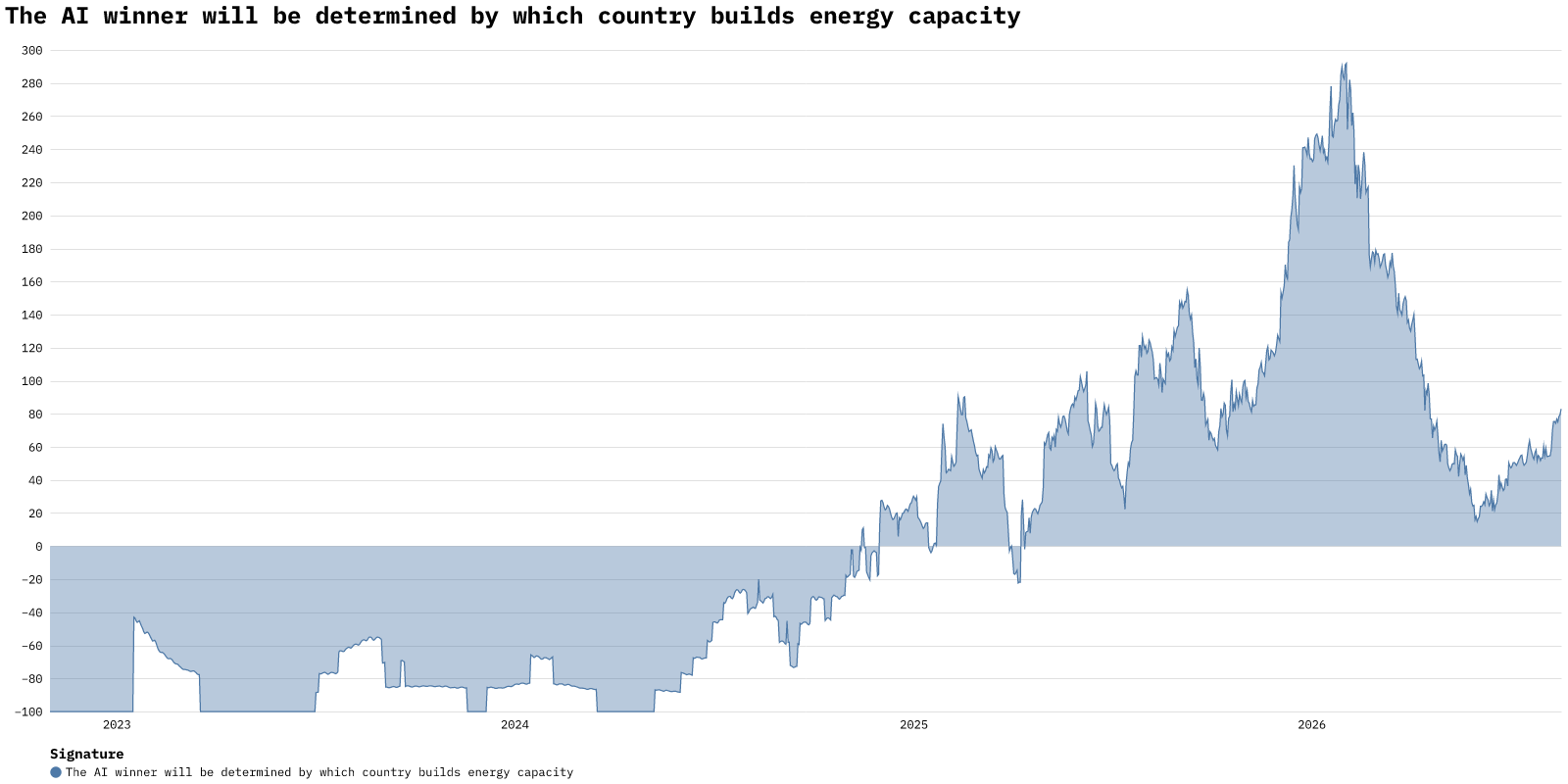
- The competitive leaderboard consolidated around Anthropic, and the national race is being framed in electricity rather than silicon. Language asserting Anthropic or Claude leadership held at the strongest competitor reading in the file, backed by disclosed revenue, positive adjusted operating income, and a confidential IPO filing, while OpenAI- and Google-leadership language sat below baseline. Grok and DeepSeek signatures posted the fastest gains on shipping cadence and pricing. Above the firm race, language arguing that energy infrastructure determines AI leadership climbed sharply — a frame that links the competitive story directly to the grid constraints above it, and one that positions Anthropic's disclosed financials as counter-evidence against the crash narrative.
AI's Media Frame Splits Three Ways: Crash Talk Rises Without Disillusionment, the Binding Constraint Shifts From Chips to Memory and Grid Politics, and the Leaderboard Consolidates Around Anthropic
Bubble Language and Capex Conviction Strengthen in Parallel, With the Payoff Story Still Absent
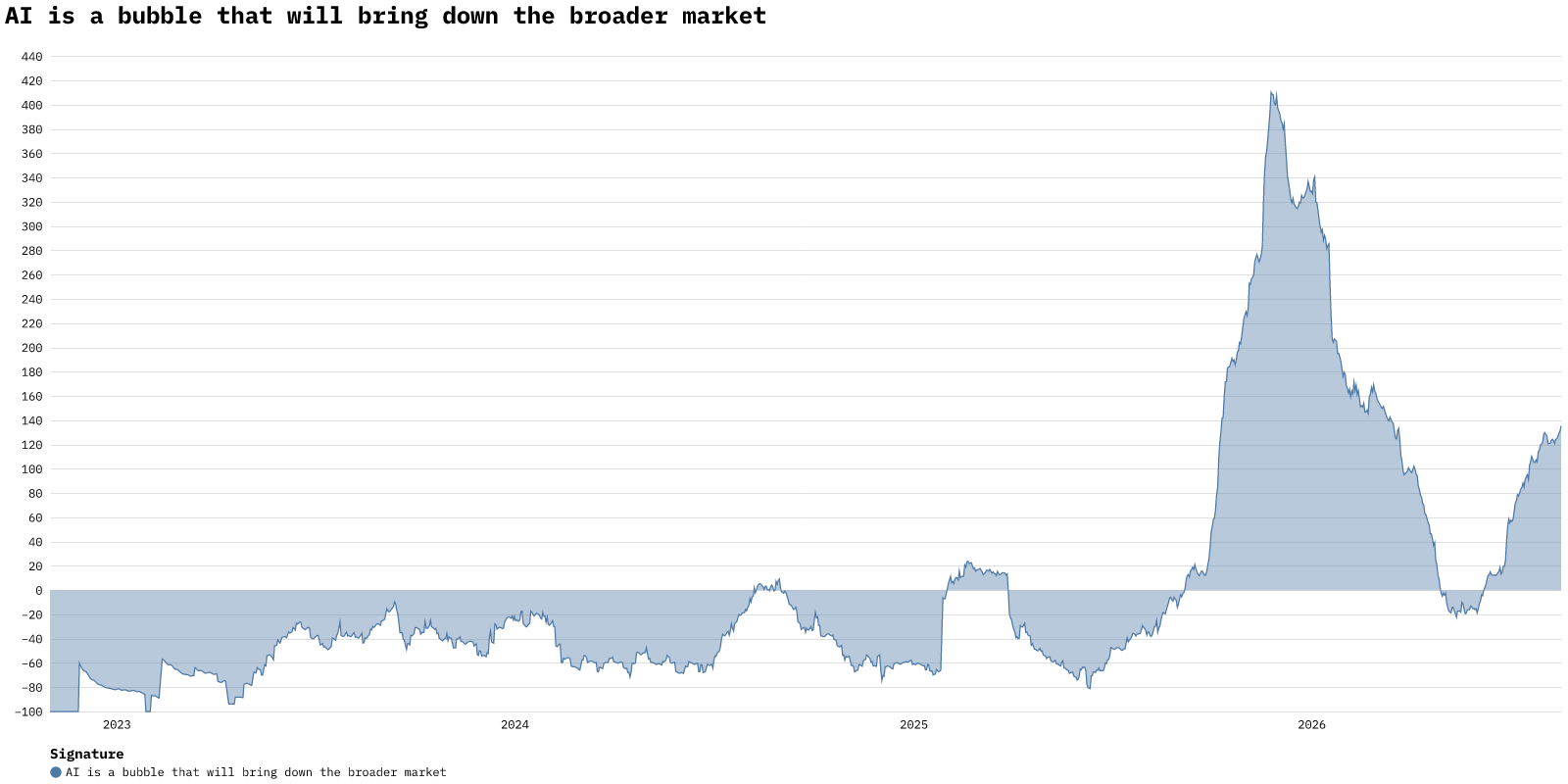
The dominant financial frame this week is systemic risk. Perscient's semantic signature tracking the density of language predicting that an AI investment collapse will crash overall markets posted the largest weekly gain among the market-risk signatures, rising by 12.2 to an Index Value of 135.4, a level well above its long-term mean. Ray Dalio warned that runaway enthusiasm around AI mirrors 1929 and 2000, arguing that market participants are taking on excessive leverage while ignoring valuations, on the same day Evercore ISI projected the S&P 500 could reach 9,000, a juxtaposition Benzinga described as a stark divergence. ECB researchers joined the caution camp, writing that a correction of current stock market valuations is likely because AI-driven valuations echo the dot-com era.
 Source: Perscient
Our signatures tracking language asserting that businesses increasingly doubt large AI spending, characterizing AI infrastructure spending as a dangerous gamble, and asserting that hyperscale projects face doubts all moved higher together, the last of these reaching 52.2.
The bull case strengthened simultaneously rather than yielding. Perscient's signature tracking language asserting that AI infrastructure spending is massive and increasing gained by 9.7 to 75.5, and the signature tracking assertions that the AI investment theme remains durable rose alongside it. Reuters captured the bullish half, reporting that capex angst is fading among big investors who now treat today's capex as tomorrow's sales, and J.P. Morgan lifted its year-end S&P 500 target to 8,000 on the argument that elevated backlogs converting into recognized revenue should validate rising AI capex.
Our measure of language claiming AI hype is giving way to a disappointment phase declined to -25.2, and the measure of language asserting AI represents an excessive portion of market valuation also slipped. Media is discussing a crash scenario without adopting either the disillusionment or the concentration-risk framing that would normally accompany it.
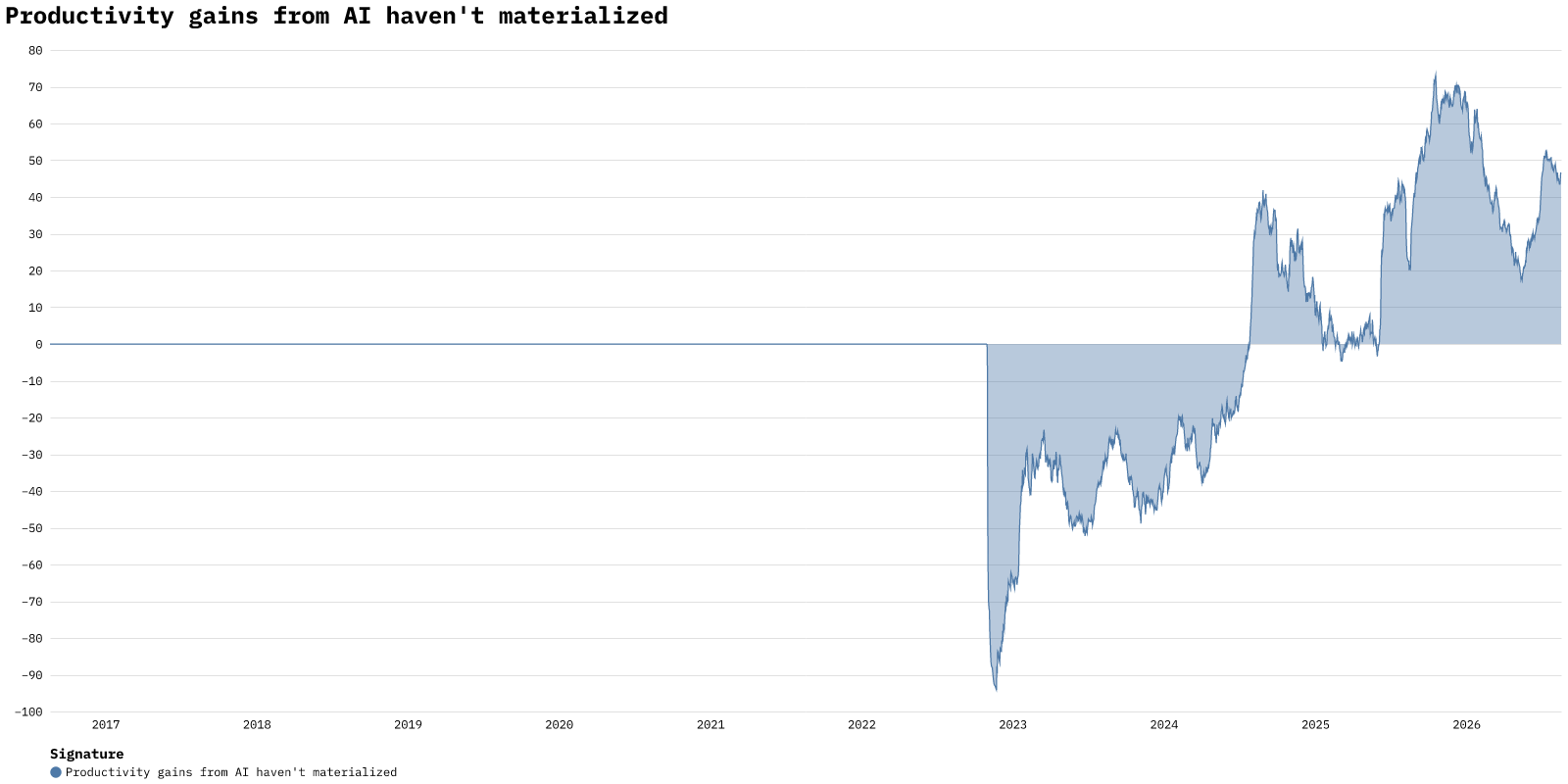
What keeps the debate alive is the absence of a payoff story. Bloomberg identifies rates, not AI fundamentals, as the swing factor, noting that AI-related capital expenditures aren't expected to fully pay off for years, while the four largest hyperscalers plan roughly $725 billion of 2026 capex, up about 77% from last year's record. Our signature tracking assertions that promised AI efficiency improvements have not occurred sits essentially flat at 46.5, and the counterpart tracking claims that AI advances are translating into company profits remains near its long-term mean. Skeptics have data in circulation: an NBER study finding that 89% of managers saw no productivity change over three years even as 91% of companies report AI use, and Apollo's Torsten Slok arguing that chipmakers' 41% margins depend on model makers' negative 59% operating margins staying financeable.
 Source: Perscient
Perscient's signature connecting AI to efficiency improvements and universal basic income posted the largest one-week decline in the entire set, and the signature predicting a long-term investment supercycle, though recovering somewhat, remains the weakest of the durable-bull frames. Near-term capex conviction is being asserted without the long-duration argument behind it. The labor dimension is likewise absent from the week's discourse, and the fiber-overbuild analogy is not carrying the bear case either; commentators are invoking systemic market risk directly.
The Bottleneck Story Moves Off the GPU and Onto Memory, Sites, and Grid Politics
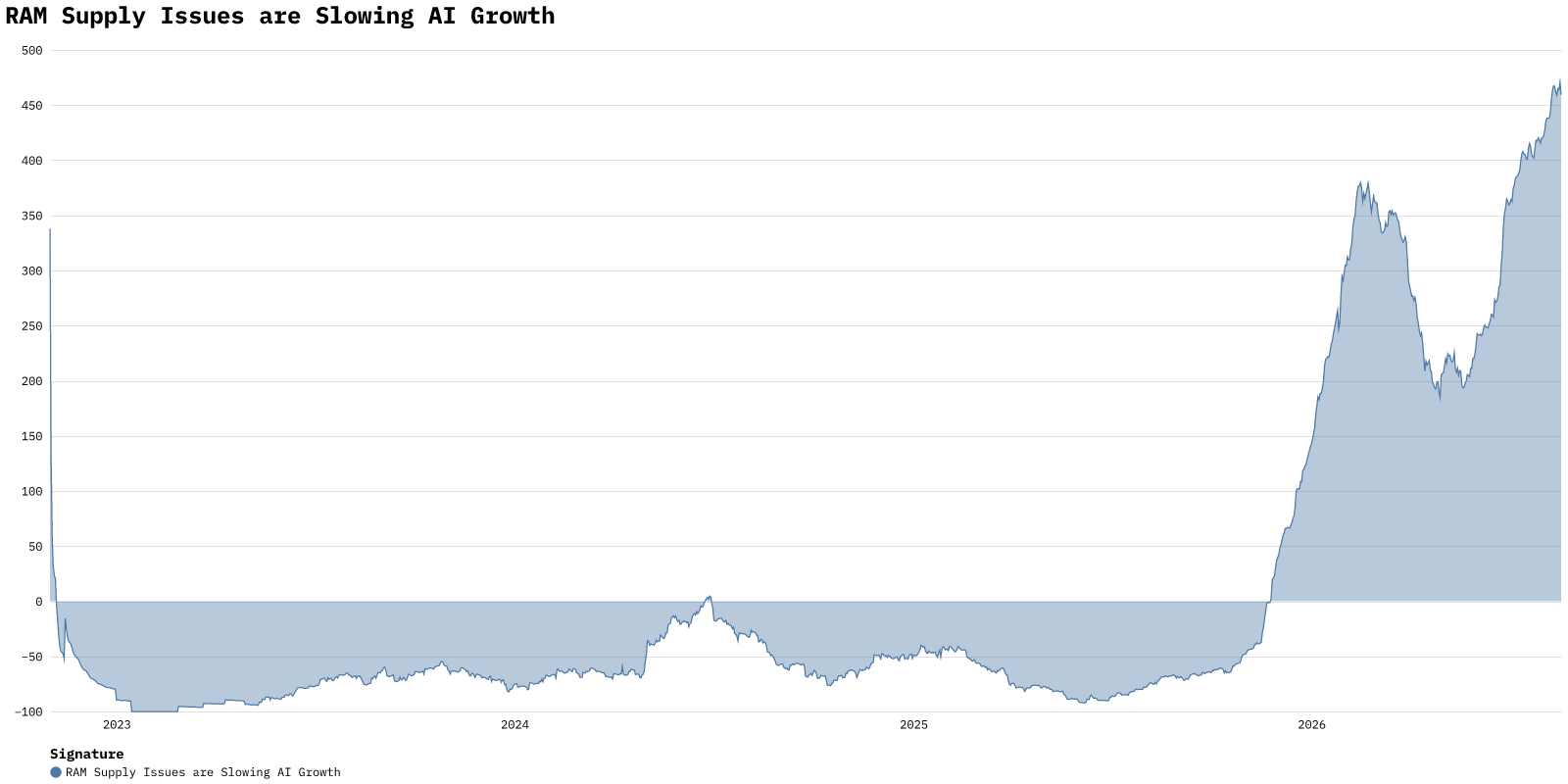
Perscient's semantic signature tracking the density of language asserting that memory chip shortages are slowing AI growth is the highest reading in the entire file at an Index Value of 459.3, easing by 8.0 on the week but remaining far above its long-term mean. Our signature tracking claims that GPU shortages are slowing AI growth sits at just 6.6, effectively at its long-term mean. Accelerator scarcity has been displaced as the narrative constraint.
 Source: Perscient
J.P. Morgan estimates DRAM prices will have risen more than 400% from the start of 2024 through the end of 2026, and IDC forecasts data centers will absorb about 70% of all memory produced worldwide in 2026, up from 20-30% as recently as 2022, with supply growth well below historical norms. DigiTimes reported that Samsung, SK hynix and Micron have now sold their entire DRAM and HBM production capacity through 2027. Tim Cook has called the market "a 100-year flood on memory pricing," and widely shared posts noted demand growing near 200% against roughly 20% supply growth and German DDR5 retail prices at five times their July 2025 levels.
Behind memory sit sites and power. Our signature tracking assertions that data center construction delays are slowing AI growth rose to 160.7, the second-most prominent constraint narrative. Meanwhile, the signature tracking claims that slow grid interconnection approvals are slowing AI growth moderated by 24.7, the largest weekly decline in the file, yet it remains one of the strongest constraint readings. FERC directed regional grid operators to disclose spare capacity and file revised interconnection tariffs; data centers are required to pay the full cost of their own grid upgrades. The physical backlog is unchanged; the U.S. interconnection queue is near 2,600 GW and median waits approach five years. PJM itself asked FERC on August 13 for a framework allowing large new loads to connect early in exchange for accepting curtailment when capacity falls short, citing roughly 70 GW of expected new large-load demand by 2038. PJM capacity prices moved from $28.9/MW-day in 2024/25 to $329.2/MW-day for 2026/27.
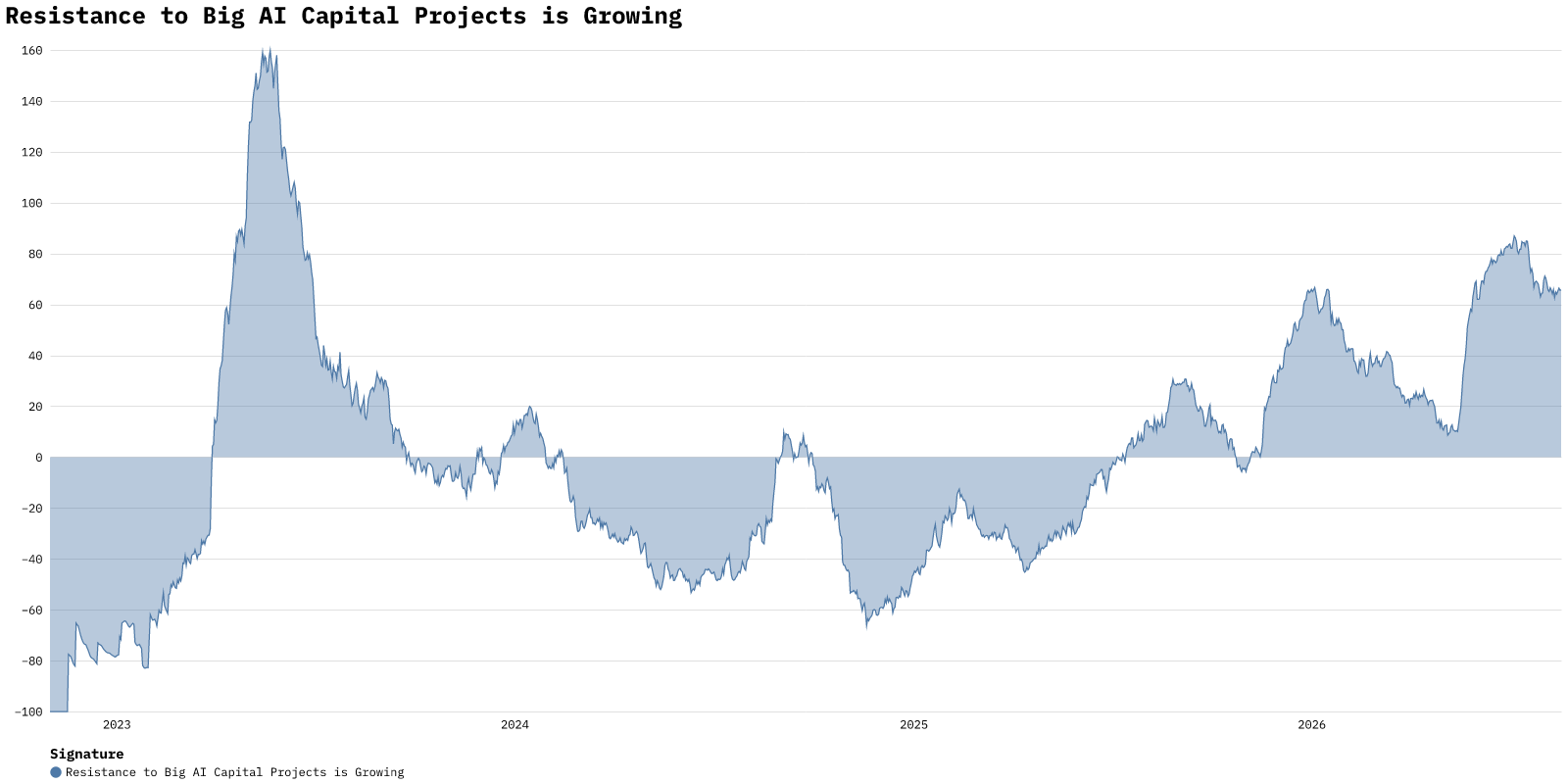
That cost pressure feeds directly into local politics. Perscient's signature tracking claims that opposition to large AI investments is increasing was unchanged at 65.7. Rep. Ro Khanna pressed his Data Center Bill of Rights on Meet the Press, arguing local communities should decide whether facilities get built, against a backdrop of a March Gallup survey finding 71% of Americans opposed to a data center near them. During the week, Fort Worth's City Council voted unanimously toward a 90-day moratorium, Maryland counted 13 county-level moratoriums and one outright ban, and Colorado localities enacted their own pauses. Our signature tracking claims that limited access to quality training data is slowing AI growth was flat at a modest level. These physical signatures are the most credible mechanical support for the doubts about hyperscale projects discussed in Section 1.
 Source: Perscient
A Two-Firm Commercial Race Inside a Two-Nation Energy Race
The question of who is winning consolidated further. Perscient's semantic signature tracking the density of language asserting that Anthropic or Claude leads the AI competition holds at an Index Value of 173.7, essentially flat on the week, the strongest competitor-leadership reading in the file and the second-highest reading overall. Anthropic's annualized revenue run rate topped $65 billion by the end of July, up more than sevenfold from the end of 2025, with preliminary quarterly revenue above $11.5 billion against $787 million a year earlier and positive adjusted operating income. The company has filed confidentially for an IPO with Morgan Stanley, Goldman Sachs and JPMorgan and could trade as early as this fall, ahead of OpenAI; the valuation hinges on 2028 revenue projections of roughly $190-200 billion.
 Source: Perscient
Our signatures tracking assertions that OpenAI leads and that Google or Gemini leads are both flat and meaningfully below their long-term means; reporting places OpenAI's run rate at $40 billion on most recently disclosed figures, though the two companies may not measure revenue identically. The fastest mover among competitor signatures was our measure of language asserting that Grok or xAI leads, up by 10.8 to 38.5. Grok 4.6 shipped on August 12 as a frontier agentic and coding model priced at $2 per million input tokens and $6 per million output tokens, drawing enthusiastic early reviews and a tie for the top spot on the Artificial Analysis Agentic Index. Grok 5 has not shipped and has no model card or public benchmark; the signature is tracking cadence and expectation, not a released frontier model.
Perscient's signature tracking claims that DeepSeek or China leads rose by 9.5 to 32.8 following the general availability release of V4-Pro on August 13, focused on agentic tool use; a price increase raised peak output pricing to $4.0 per million tokens. Even at the new rates, DeepSeek's prices remain below Western frontier pricing.
Above the firm-level race sits a national one, framed increasingly in electricity rather than silicon. Our signature tracking language asserting that the country which builds the best energy infrastructure will determine AI leadership rose by 7.7 to 83.0, one of the larger weekly gains in the file. Supporting coverage argues China added grid power at roughly eight times the U.S. pace in 2025, Mark Zuckerberg warned that China is bringing online more than a gigawatt of nuclear capacity every other week, and OpenAI has urged up to 100 GW of new annual U.S. generating capacity, calling electricity a strategic asset. Meanwhile our signature tracking claims that the future AI leader has not yet been founded was unchanged; coverage is consolidating around named incumbents, not unknown entrants.
 Source: Perscient
Anthropic's disclosed revenue and positive adjusted operating income are now being deployed as counter-evidence against the market-crash framing of Section 1, while the energy and memory constraints of Section 2 set the ceiling on how fast anyone can press an advantage. Expect the IPO window, competitor pricing moves, and national energy build metrics to move all three narratives simultaneously over the coming weeks.
