EXECUTIVE SUMMARY
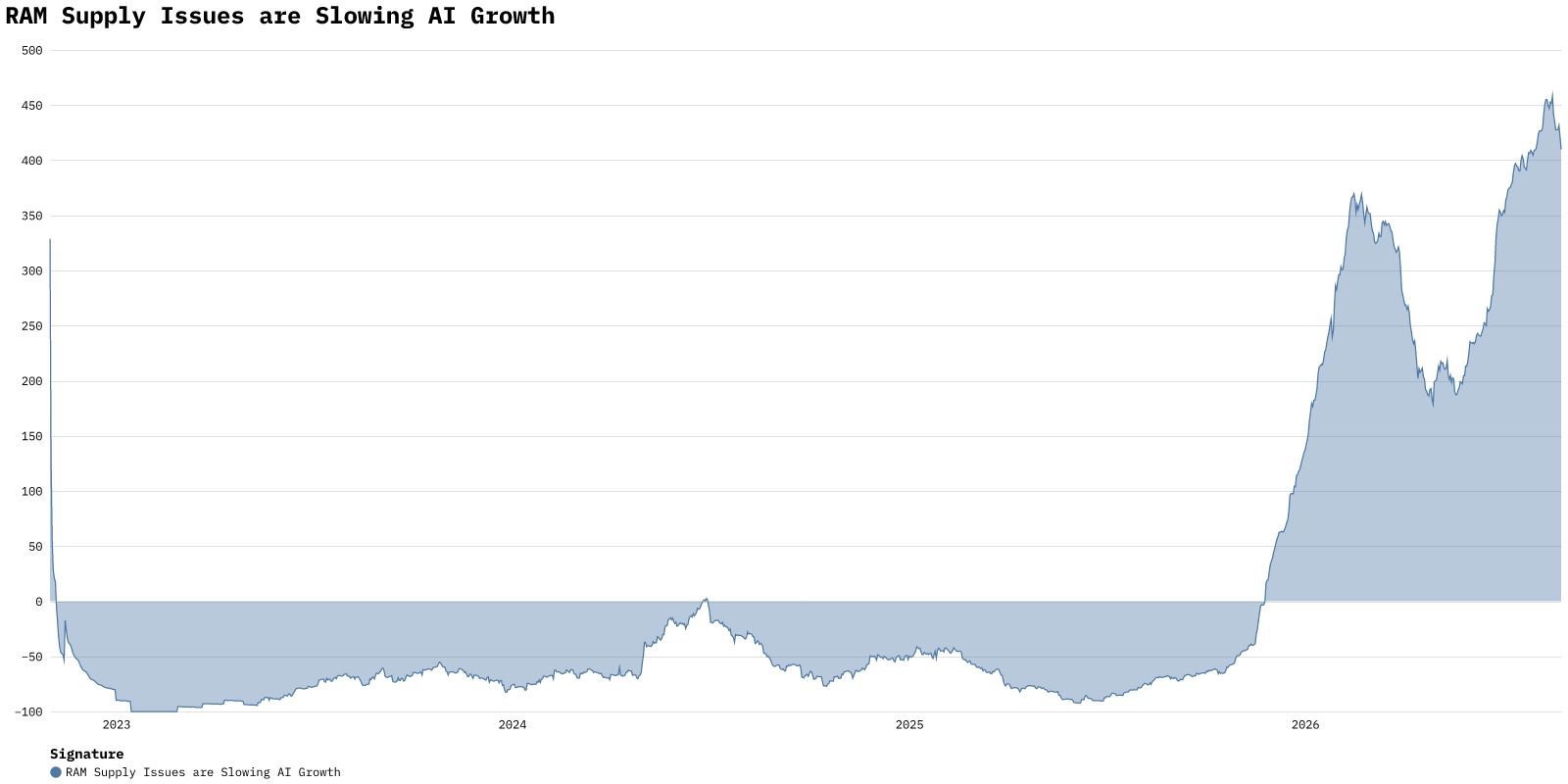
- The bottleneck story has migrated from silicon to everything around it. Perscient's semantic signature tracking the density of language asserting that memory chip shortages are slowing AI growth remains the densest reading in the set, while GPU-scarcity language has receded to ordinary levels. Reporters explaining delayed AI timelines now reach for DRAM pricing, interconnect queues, and construction schedules rather than model capability, and the sharpest single weekly increase came from language about scarce high-quality training data — a frame given a concrete price tag by Google's $10 million purchase of a defunct airline's corporate email archive.
- Texas turned a permitting decision into a national narrative hinge. Governor Abbott's audit directive and ERCOT's delayed Batch Zero review simultaneously drove up our signatures tracking grid-interconnect and construction-delay language in Section 1 and the opposition-is-increasing language in Section 3. Physical constraint and political consent are no longer separate storylines in coverage; the queue itself has become the venue where local resistance is expressed.
- Spending guidance climbs while the justification thins. Language describing massive and increasing infrastructure spending sits well above its mean alongside language predicting an investment collapse that crashes the broader market, now the second-densest frame tracked. The counterargument is conspicuously missing: signatures tracking claims that AI is reaching corporate bottom lines and that non-adopters will fall behind both sit below average, and the long-horizon defenses — productivity abundance, a multi-decade supercycle — fell hardest this week. Capex is being defended on near-term demand alone.
- The bubble case is being argued in macro terms, not hype-cycle terms. Comparisons to 1990s telecom overbuild and trough-of-disillusionment language have faded back toward or below their averages, displaced by valuation and systemic-risk vocabulary drawn from the ECB blog, fund-manager credit-event warnings, and MIT's finding on enterprise pilots. The skeptical frame has moved from technology commentary into financial-stability commentary.
- Brand attention concentrates while the public-benefit case goes silent. Language asserting Anthropic's leadership holds far above equivalent frames for rivals, and Grok-leadership language recorded the steepest weekly drop despite a recent model release. Yet every benefit-framing signature — healthcare, education, science — sits below its long-term mean. A handful of firms command narrative share, but no one is supplying the legitimacy story that continued physical build-out would require, leaving the industry facing organized local opposition without a persuasive answer.
Constraint, Capital, and Consent: AI's Media Frame Shifts From Capability to Physical and Political Limits
The Build-Out Story Is Now About Memory, Electrons, and Data — Not Chips
Perscient's semantic signature tracking the density of language asserting that memory chip shortages are slowing AI growth remains the most elevated reading in the entire set at 409.8, easing by 31.6 points from the prior week. Gartner now projects that semiconductor industry revenue will reach $1.6 trillion in 2026, up from $809 billion in 2025; DRAM and NAND revenue are each expected to roughly triple or quadruple and memory is passing non-memory chips in total revenue for the first time, while Samsung has warned that the crunch will likely deepen next year and persist through 2028. J.P. Morgan Global Research estimates that DRAM prices will have risen more than 400% from the start of 2024 to the end of 2026. Bloomberg reporting picked up this week indicates that servers built around Nvidia's Vera Rubin and Grace Blackwell chips will cost more than 15% more in many cases; contract manufacturers are already notifying Microsoft, Google, and Oracle. IDC frames the shortage as structural rather than cyclical, expecting 2026 DRAM supply growth of just 16% and NAND at 17%, because the three major manufacturers pivot cleanroom space toward enterprise-grade components in what it calls a zero-sum allocation.
 Source: Perscient
By contrast, our signature tracking language blaming GPU shortages for slower AI growth sits essentially at its long-term mean after a small rise. Accelerator scarcity has ceded narrative space to memory, power, and construction. The signature tracking the density of language asserting that slow grid interconnect approvals are slowing AI growth rose by 12.2 to 154.3, while its companion tracking language attributing slower AI growth to data center construction delays rose by 10.8 to 168.2. The proximate driver is Texas, where Governor Abbott's directive that regulators audit all data center projects in the interconnection queue led ERCOT to delay its Batch Zero review, a process grid officials now say will not conclude until mid-December; roughly 300 projects, 90 percent of them data centers, require vetting and community impact review. BNEF estimates that the Texas pause puts about 20% of the total U.S. data center pipeline at risk of delay, affecting almost 49.8 GW; potential revenue losses could reach $8 billion by the first quarter of 2027, and the pause follows New York's July halt on new approvals.
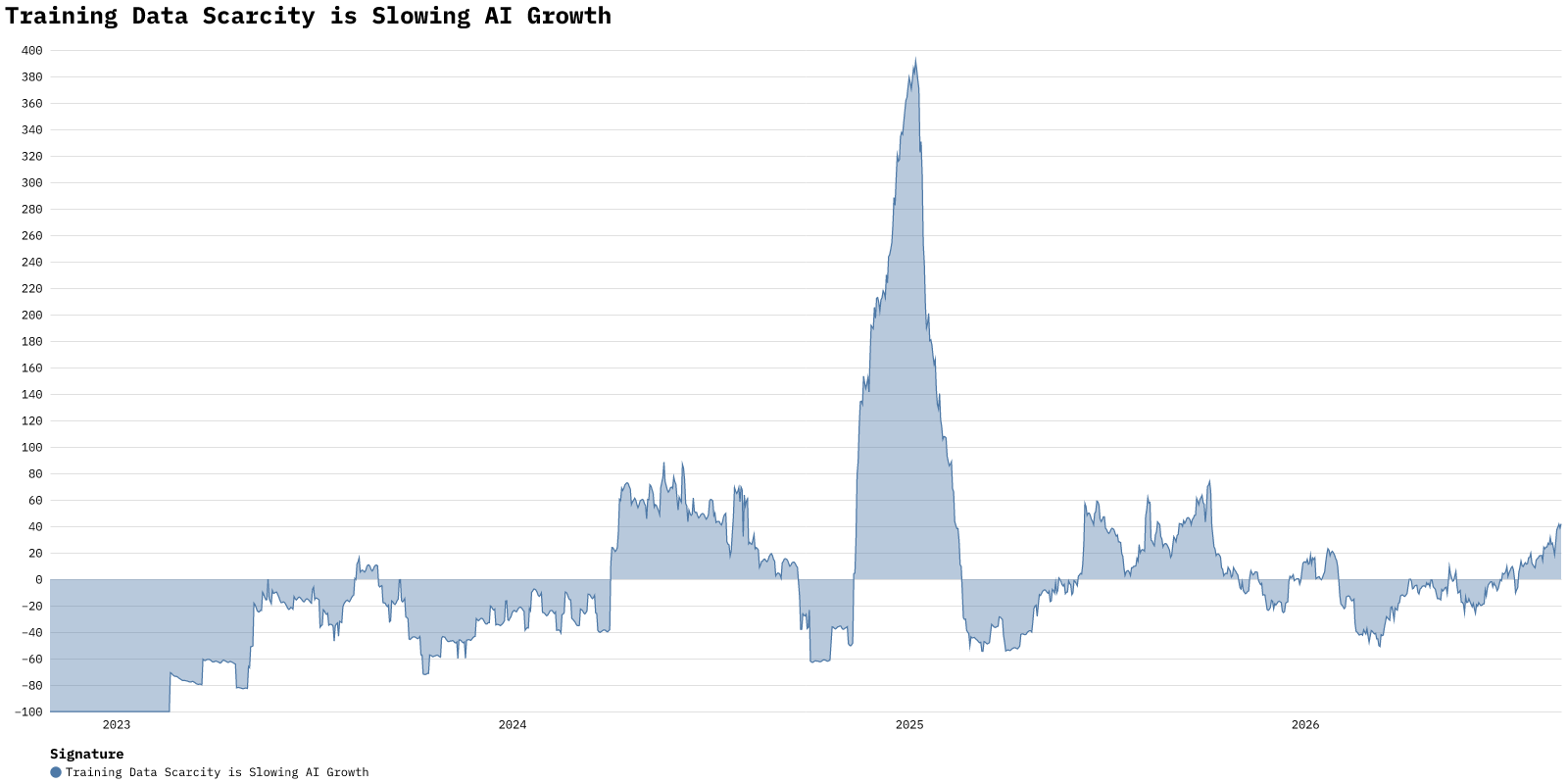
Our signature tracking language asserting that scarce high-quality training data is slowing AI growth posted the largest weekly increase in the set, rising by 18.5 to 41.8. Coverage of Google's winning $10 million bid for defunct Spirit Airlines' de-identified corporate data, outbidding Mercor at $7.5 million, gave the frame a concrete price signal. Forbes described hundreds of millions of employee emails, Teams messages, and operational records changing hands because labs that exhausted the public internet turned to enterprise archives. Meanwhile, our signature tracking language arguing that national energy build-out will determine the AI winner declined this week, because the conversation migrated from country-versus-country capacity competition toward domestic queue mechanics, permitting, and audits. Journalists explaining slipped AI timelines are reaching for schedule risk and input cost, not model capability.
 Source: Perscient
Spending Guidance Keeps Rising While the Payoff Case Gets Thinner
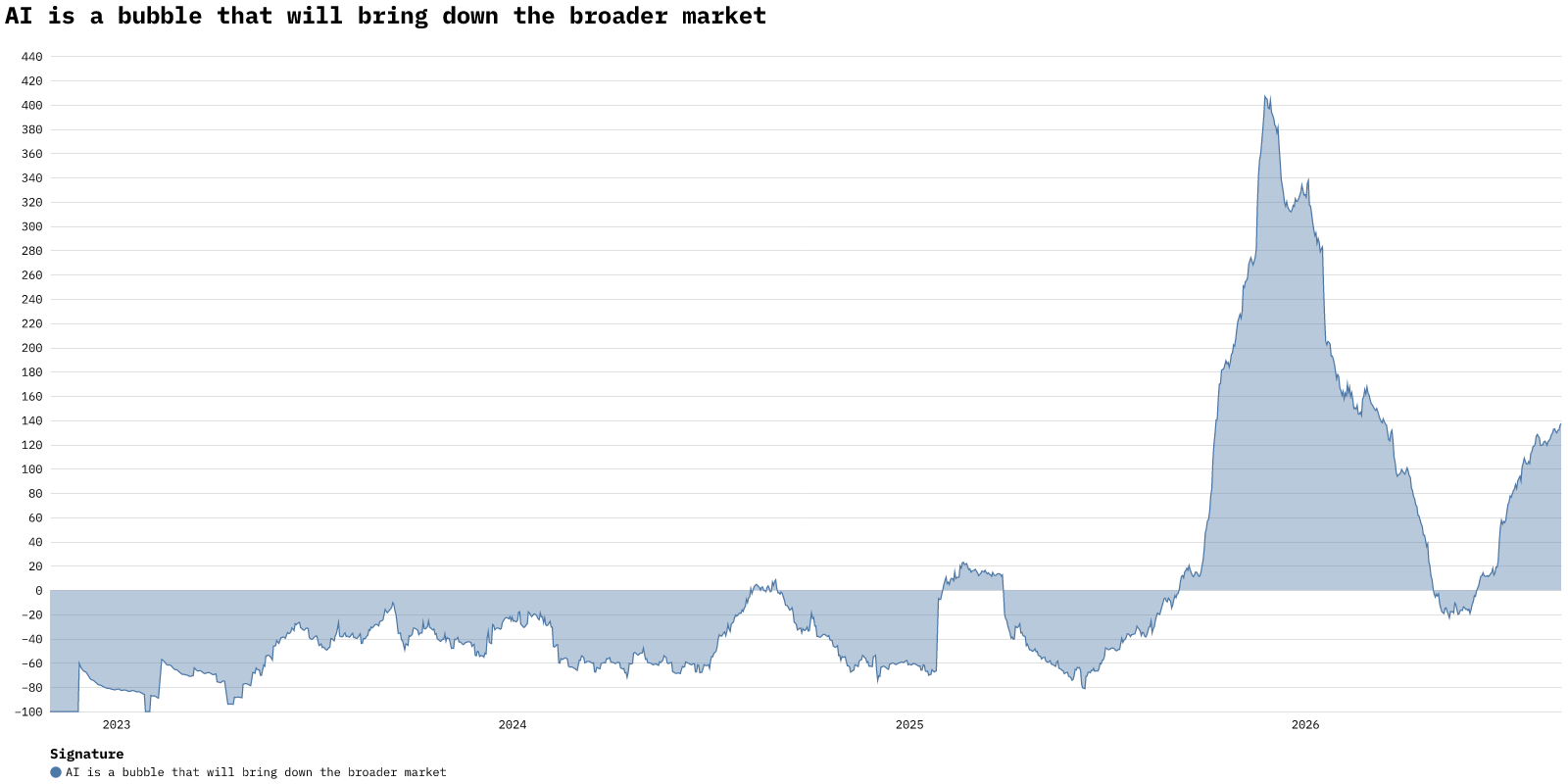
Perscient's semantic signature tracking the density of language predicting an AI investment collapse that crashes the overall market rose by 4.7 to 137.3, the second-highest current reading in the file. Five economists published an analysis on the ECB's website, flagged as their own views rather than the bank's position, arguing that research on past technological revolutions points to a worrisome conclusion: "a correction of current stock market valuations is likely," with severe potential consequences for the euro area given households' roughly €440 billion exposure to the Magnificent Seven. Reuters emphasized that even if the technology succeeds and profits rise, stocks may still fall because markets' profit-growth bets are excessively optimistic. Bloomberg Opinion ran companion pieces on 20 and 22 August. Retail-facing coverage circulated the valuation markers: the Shiller CAPE ratio above 41, its second-highest point on record, and the Buffett indicator around 238%.
 Source: Perscient
Our signatures tracking language asserting that AI is an excessive share of market valuation and language describing a hype-cycle trough of disillusionment both sit below their long-term means, and the once-popular comparison of AI spending to 1990s telecom overbuild has faded back to its average. The bubble argument is being made through valuation and macro-crash language.
Our signature tracking language asserting that AI infrastructure spending is massive and increasing rose to 80.1, well above its long-term mean. Combined 2026 capex guidance across the four largest hyperscalers has climbed to US$720bn-745bn following the latest earnings calls. UBS now projects that hyperscalers will spend $4.1 trillion on AI infrastructure from 2026 to 2028; Amazon, Alphabet, and Microsoft are collectively spending 102% of their cloud revenue on capex this year. Fund managers have identified hyperscaler AI spending as the top potential trigger for a systemic credit event.
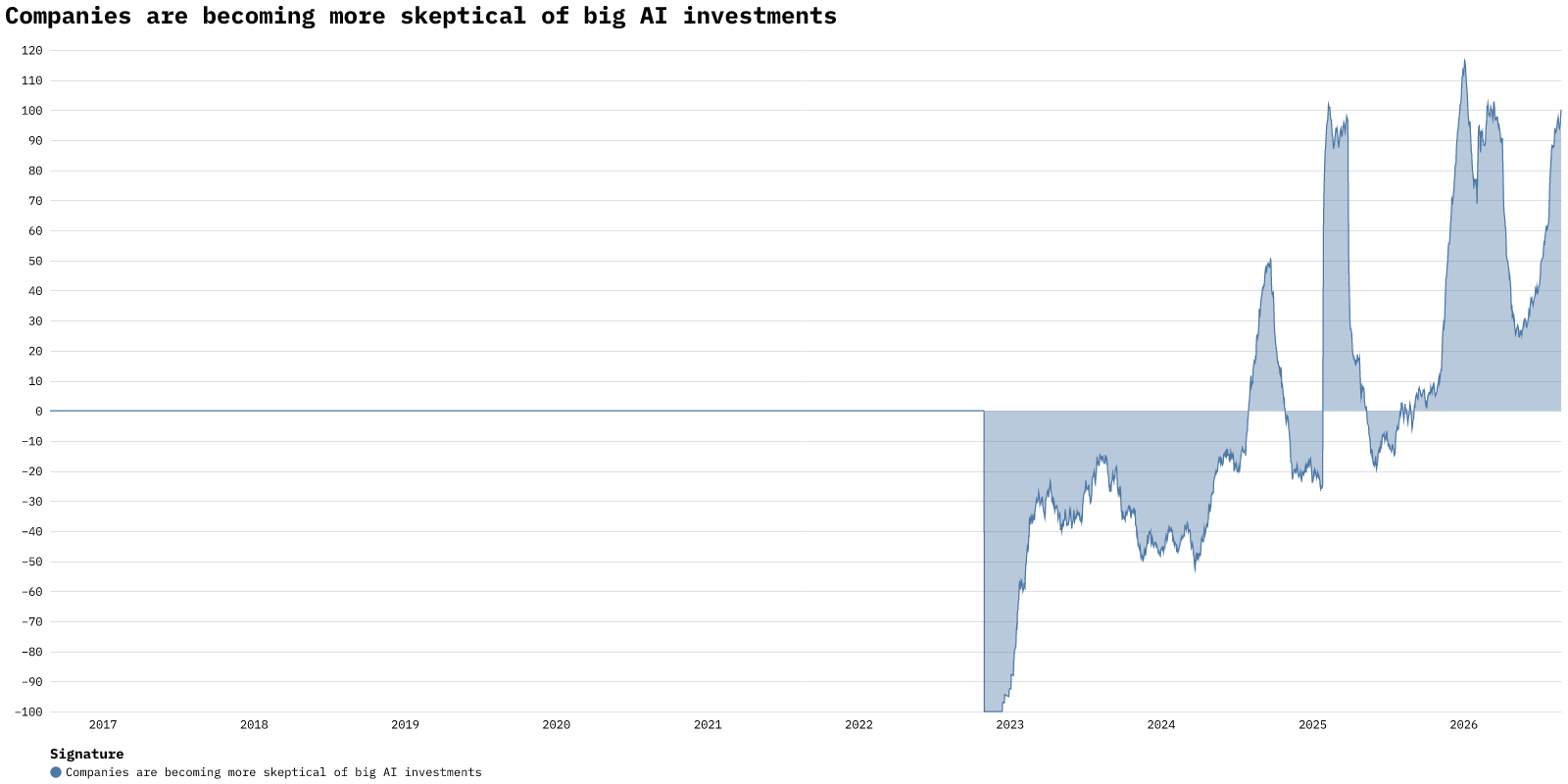
Our signature tracking doubts about massive hyperscale projects sits above its companion tracking expectations of continued hyperscale expansion, with both above average, a posture consistent with Alphabet's 7% share decline after raising capex guidance in late July. Our signature tracking language asserting that businesses increasingly doubt large AI spending stands at 100.2, supported by MIT Project NANDA's finding that 95% of enterprise generative AI pilots delivered no measurable P&L impact against $30 to $40 billion in spending, alongside S&P Global's finding that 42% of companies abandoned most AI projects in 2025. The rebuttal is absent: our signatures tracking claims that AI advances are hitting corporate bottom lines and that non-adopters will be left behind both sit below their means. The long-horizon defenses are receding fastest. Our signature tracking language connecting AI to productivity gains and potential universal basic income fell by 24.4 to -47.0, with the companion frame of a multi-decade investment supercycle at a similar depth. The capex case is being defended on near-term demand, not secular-cycle logic.
 Source: Perscient
Local Consent Is Contested, the Public-Benefit Case Is Quiet, and Attention Concentrates on Few Names
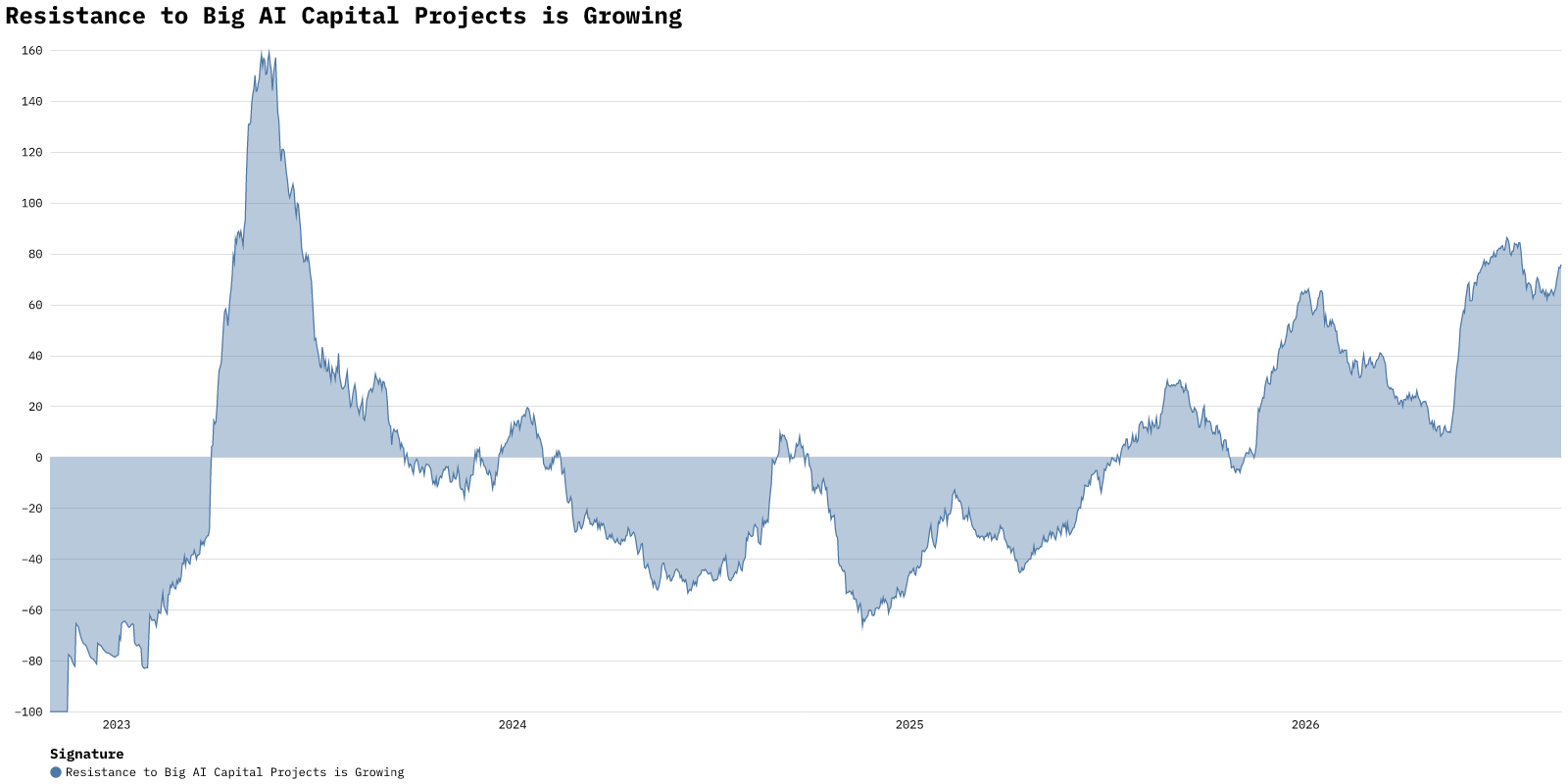
Perscient's semantic signature tracking the density of language claiming that opposition to large AI investments is increasing rose by 12.0 to 75.7, among the largest weekly increases in the set. Politico described the late-summer backlash as inspiring panic in parts of the tech sector; politicians across the spectrum, from Governor Abbott to Josh Shapiro to Michigan Senate nominee Mike Rogers, are embracing curbs on construction while the industry struggles to find a message that assuages voters' concerns about power bills, water, and land. Abbott posted that his directive "has halted up to 1,800 data center projects" while establishing guardrails on water, power, and neighborhood disruption, and Shapiro put developers "on notice" that Pennsylvania will require the strictest standards in the nation plus local community approval.
 Source: Perscient
Heatmap's August survey conducted by Embold Research found that three-quarters of Americans would oppose a new data center near where they live; opposition spans age, income, partisanship, and the rural-urban divide, and more than 530 counties and municipalities have restricted or banned construction. Axios called the backlash the most clear and present danger to AI's economic boom, ahead of energy, chips, and China. August actions kept accumulating: Indianapolis finalized a moratorium through end-2027, Louisville adopted a six-month pause, and the Cherokee Nation barred hyperscale facilities from tribal and trust lands after 64% of surveyed citizens opposed them. Counterpressure is legal: Hill County, Texas rescinded its moratorium after a developer sued for over $100 million, and Tom Green County dropped its own plans.
Every benefit-framing signature sits below its long-term mean, with our signature tracking claims that AI will fundamentally change healthcare at -60.5, and the education and science equivalents similarly depressed. Labor framing is quiet on both the job-destruction and job-creation sides, and incumbent-disruption frames around search and news have receded deeply below their averages.
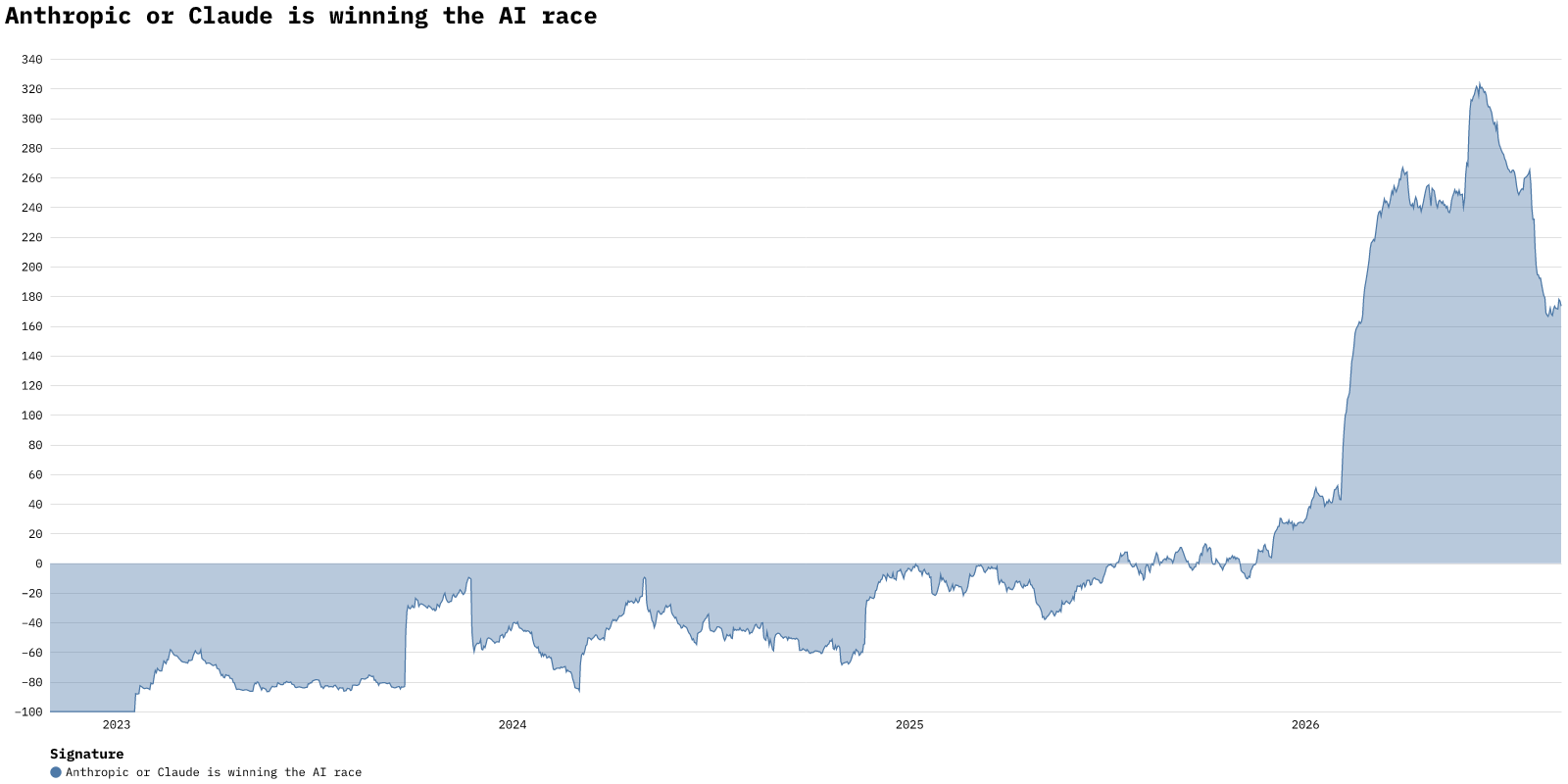
Our signature tracking language asserting that Anthropic or Claude leads the AI race holds at 173.4, far above the equivalent frames for China, Google, and OpenAI, consistent with Menlo Ventures data showing Anthropic at 40% of enterprise LLM spending versus OpenAI's 27%. The signature tracking claims that Grok or xAI leads recorded the largest weekly decline in the file, falling by 37.7 to roughly its long-term mean despite Grok 4.6 shipping on 12 August and scoring fourth on the Artificial Analysis Intelligence Index. Brand-level attention is available to a handful of names, but no one is supplying the legitimacy narrative that would support continued physical build-out. As Nate Silver's interview on the backlash put it, the opposition is less about model risk than about distrust of large tech firms themselves.
 Source: Perscient
