EXECUTIVE SUMMARY
- The bottleneck story has moved from logic to memory. Perscient's semantic signature tracking the density of language asserting that unexpected memory chip shortages are slowing AI growth is now the densest reading in the entire set, while the comparable GPU-shortage signature sits near its baseline and drifts lower. Coverage has consolidated around DRAM and HBM4 allocation, sub-10-day finished inventories at Samsung and SK Hynix, and wafer reallocation framed by IDC as potentially permanent — a supply narrative with a multi-year horizon rather than a quarterly one.
- Physical-world constraints are displacing financial-risk constraints as the dominant explanatory frame. Signatures tracking language on data center construction delays and slow grid interconnection approvals both strengthened, driven by 90-to-130-week lead times for transformers and breakers and interconnection waits of up to seven years in Northern Virginia. Read alongside the memory story, the week's coverage argues that the binding limits on AI are equipment, wafers, and electrons — not appetite for capital.
- Crash framing gave up ground, but the return-on-investment test grew more demanding. The signature tracking predictions that an AI investment collapse will crash the market posted the sharpest weekly decline in the set, and telecom-overbuild analogies fell below average. Yet signatures tracking business doubt about large AI spending and unrealized efficiency gains remain elevated, matching survey evidence that only 5% to 8% of enterprises report at-scale returns while just 6% of executives would actually cut budgets. Media have traded the bubble-pop storyline for a deferral storyline.
- Long-horizon utopian promises thinned while near-term durability claims held. Language connecting AI to broad productivity gains and universal basic income posted the second-largest weekly decline, and multi-decade supercycle predictions weakened, even as the signature asserting the investment theme remains durable stayed elevated. Coverage is narrowing its time horizon: fewer civilizational payoffs, more scrutiny of who can show a realized dollar of return.
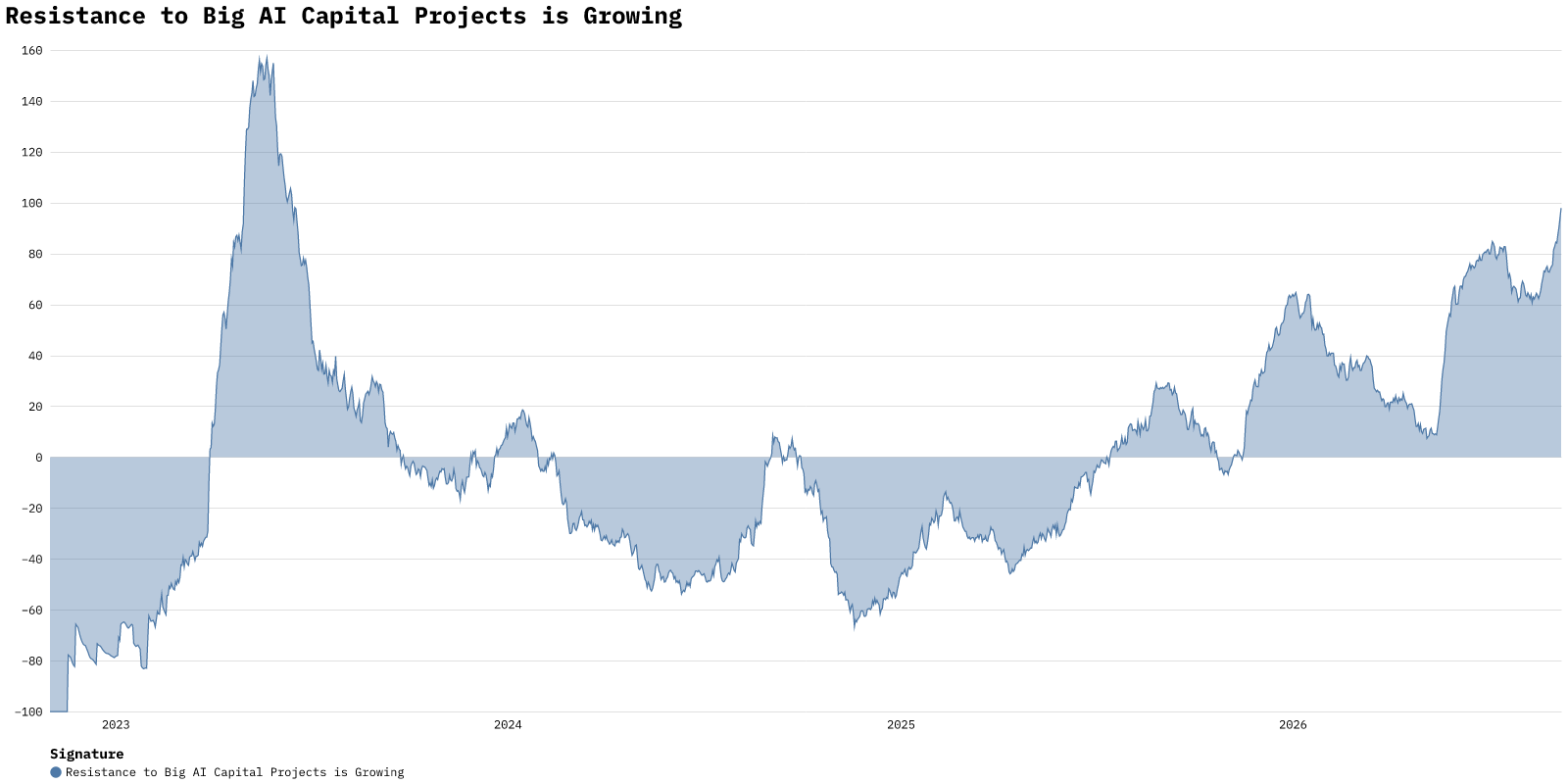
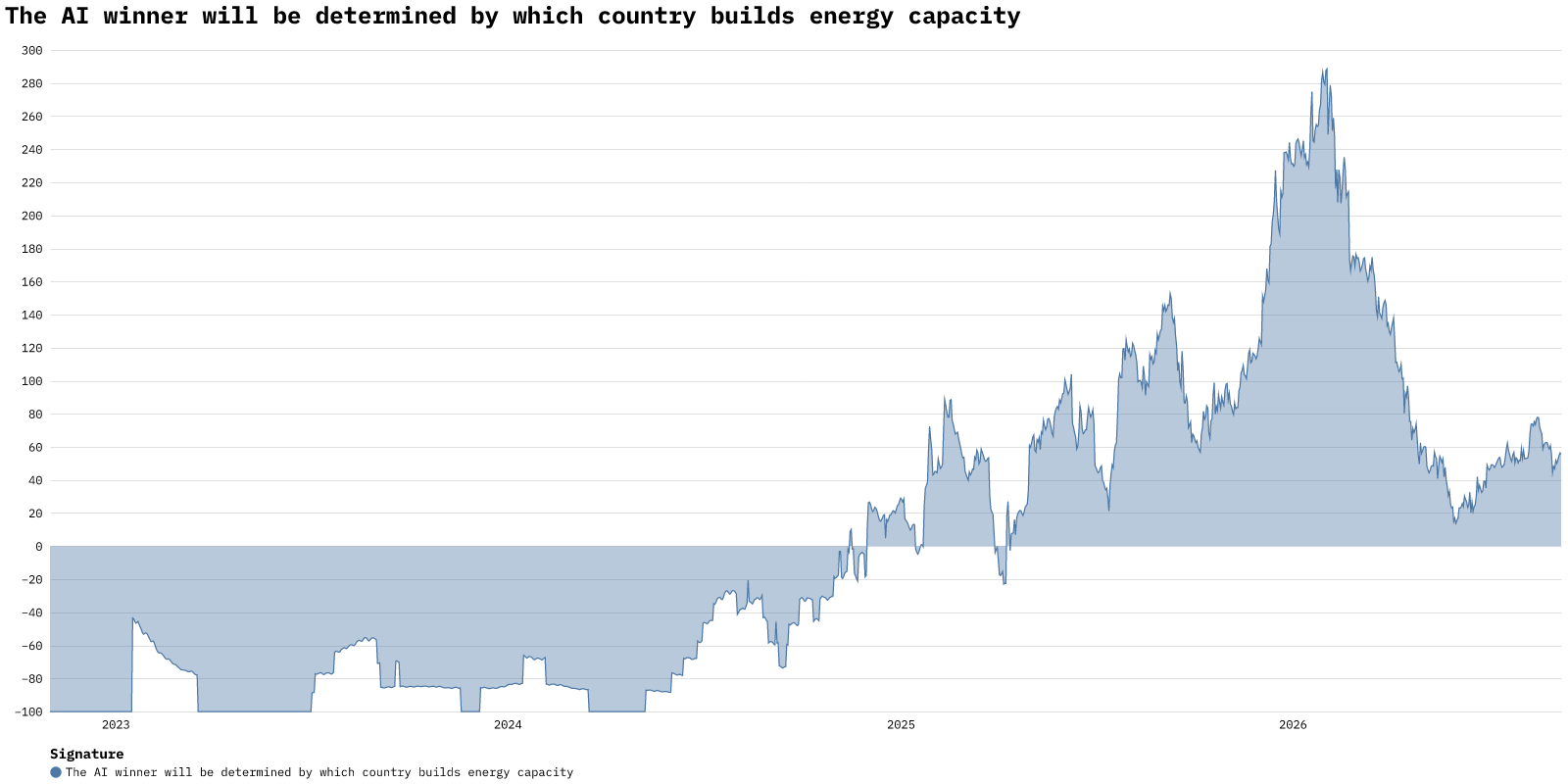
- Permission to build is emerging as the competitive frame, and it is reshuffling the leaderboard story. The signature tracking claims that opposition to large AI investments is increasing posted one of the week's largest gains, fed by more than 500 local bans and pauses, Mendocino County's 45-day ordinance, and Texas's audit of roughly 200 GW of interconnection requests. In parallel, the signature tracking the argument that energy infrastructure will decide AI leadership rose, while claims of Chinese model leadership stayed flat — capacity, not capability, is carrying the geopolitical narrative. On corporate leadership, Anthropic retains the densest race-leadership reading, xAI posted the set's largest weekly increase following its Grok Bot enterprise launch, and OpenAI's remained below average despite its Astra release.
Supply, Siting, and Sobriety: AI Coverage Pivots From Crash Risk to the Physical Limits of the Buildout
Memory — Not Compute — Now Anchors the "What's Slowing AI Down" Story
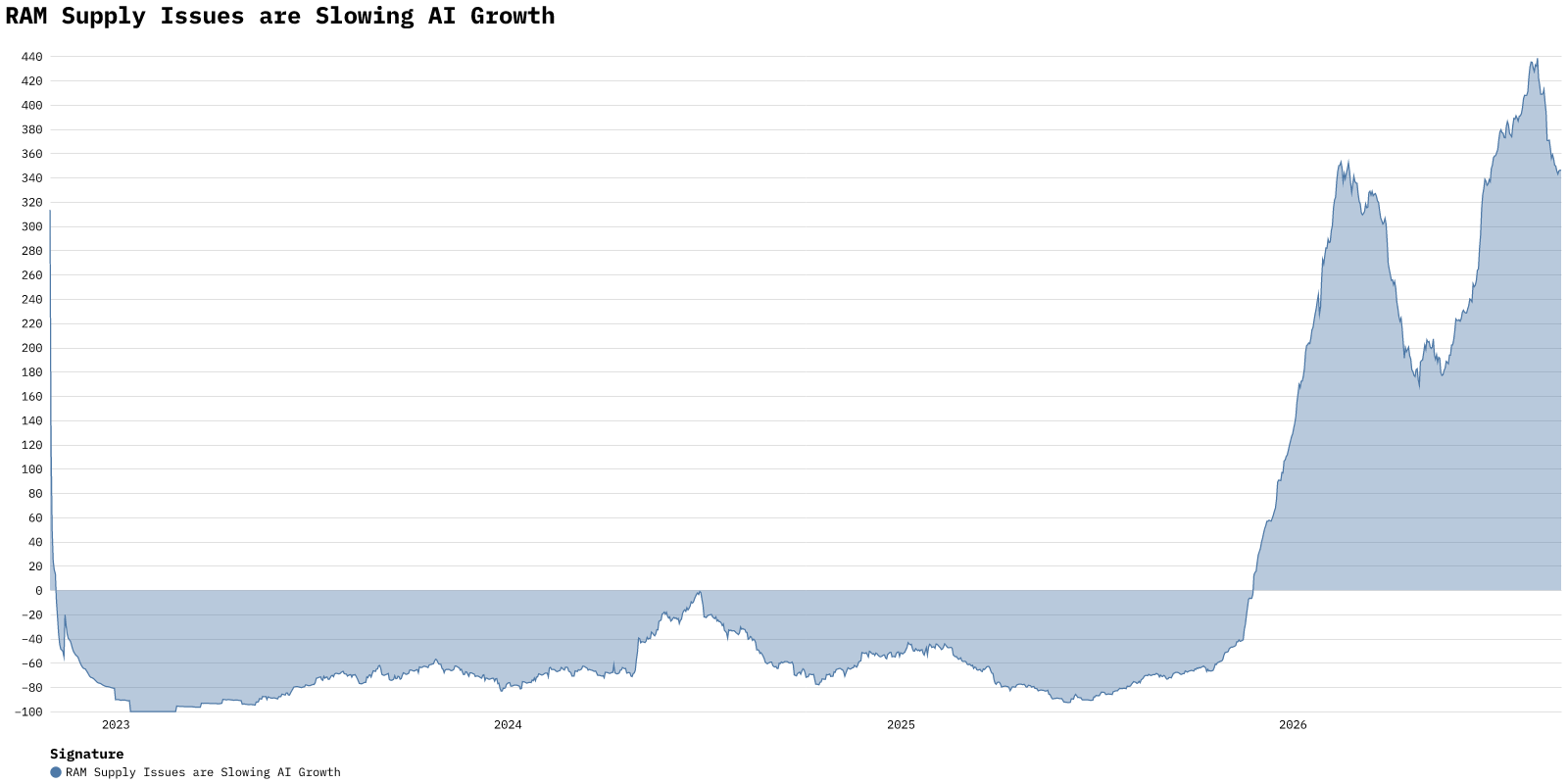
The most striking feature of this week's data is a roughly 340-point gap between two supply-side constraint signatures. Perscient's semantic signature tracking the density of language asserting that unexpected memory chip shortages are slowing AI growth reads 345.9, the highest reading in the entire signature set, easing by 9.7 points from last week but sustained at a level far above its average for at least two weeks running. Meanwhile, our signature tracking language asserting that GPU shortages are slowing AI growth sits at just 4.2, roughly average and drifting lower. The chip-shortage conversation has migrated almost entirely from logic to memory.
 Source: Perscient
J.P. Morgan Global Research estimates that DRAM prices will have risen more than 400% from the start of 2024 through the end of 2026. Analysts estimate that AI data centers could consume roughly 70% of high-end DRAM in 2026, and Avnet's assessment is blunt, "Relief is not imminent," with tight allocation possibly persisting through 2027. A September 7 KB Securities report found that Samsung and SK Hynix, which together control roughly 64% of worldwide DRAM revenue, now hold fewer than 10 days of finished inventory, and the analyst warned that "the volume available for sale itself" could be depleted next year. Because producing one HBM4 module consumes roughly three times the wafer capacity of conventional DRAM, IDC characterizes the episode as "a potentially permanent, strategic reallocation of the world's silicon wafer capacity". TrendForce's Avril Wu suggests that new production will not meaningfully change global supply until 2028, and the major producers are already selling 2027 and 2028 capacity.
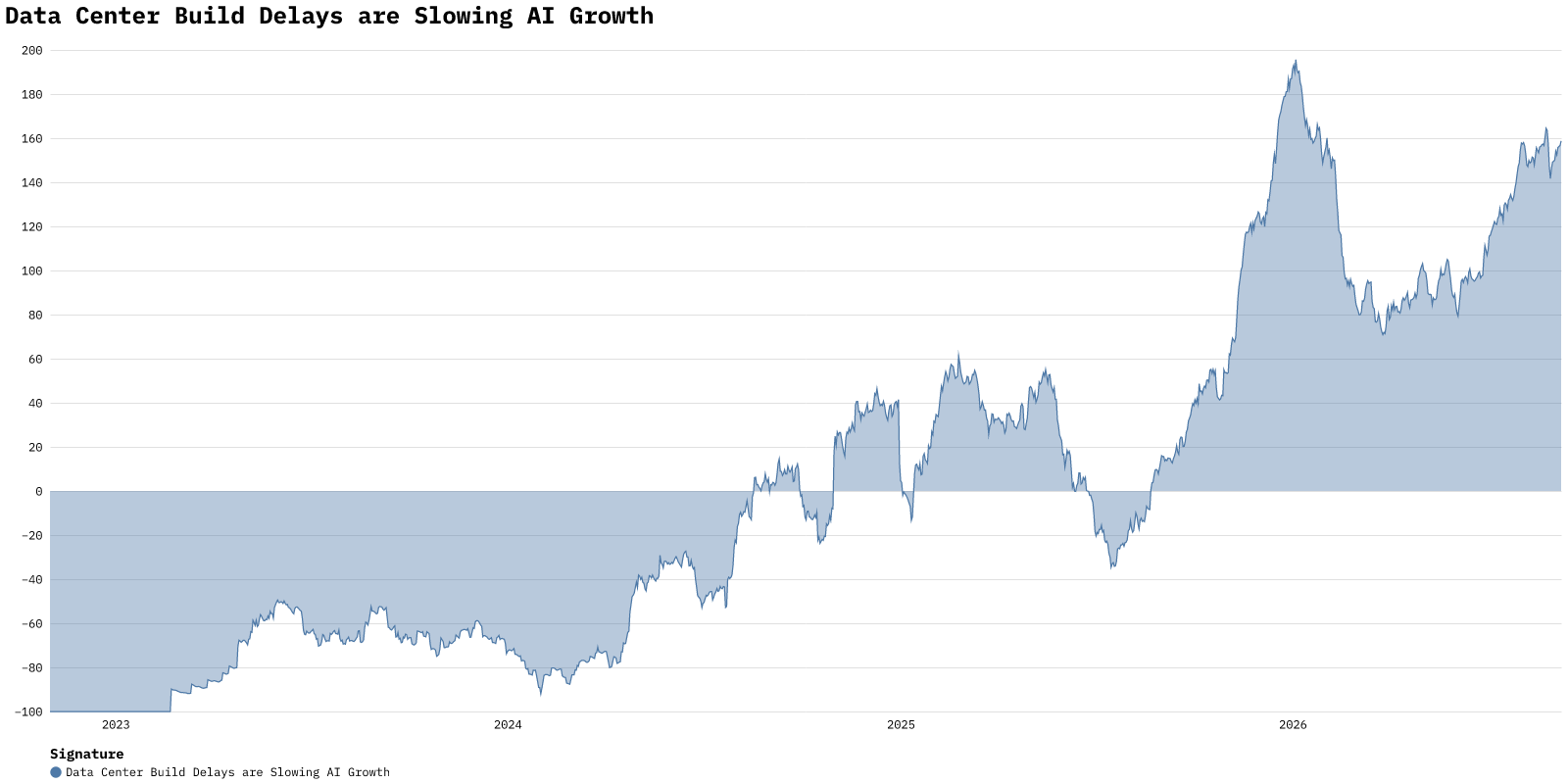
Our signature tracking language asserting that data center construction and completion delays are slowing AI growth rose by 9.2 to 158.7, the second-highest constraint reading, and the driver is equipment as much as permits: power transformers, breakers and large conductor now face 90-to-130-week lead times. The signature tracking language blaming slow grid interconnection approvals rose to 117.9, supported by IEA estimates that roughly 20% of planned global data center projects face significant delays from power access, and waits reach up to seven years in Northern Virginia and a decade in some markets. LBNL's latest Queued Up edition counted about 8,200 active projects at end-2025, a 10% decrease in total active queue volume year over year.
 Source: Perscient
Our signature tracking language asserting that AI infrastructure spending is massive and still increasing was essentially flat at 78.8. The items to watch are memory cost pass-through into 2027 product pricing and any renegotiation of hyperscaler supply commitments, particularly given that KB Securities projects memory's share of AI infrastructure spend rising from 14% in 2025 toward 57% in 2027.
Crash Framing Recedes, but the Return-on-Investment Test Hardens
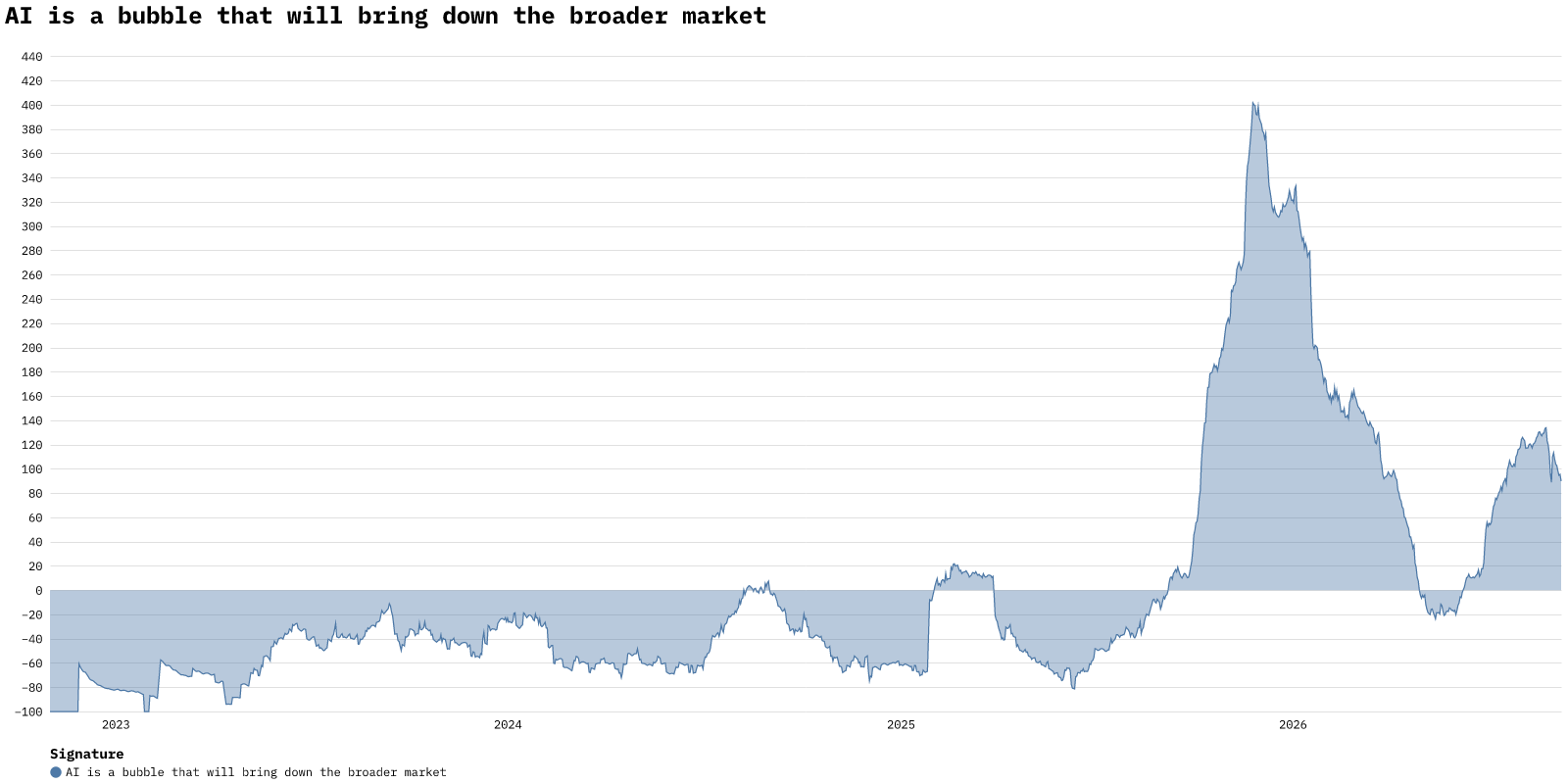
Perscient's semantic signature tracking the density of language predicting that an AI investment collapse will crash the overall market fell by 23.3 points to 89.8, the largest single-week decline in the set. Even after that drop, the reading remains well above its long-term mean. Our signature tracking language comparing AI spending to the telecom overbuilding of the 1990s fell to below-average territory, as did the signature tracking claims that AI represents an excessive portion of market value. The "1999 redux" storyline lost airtime this week, even as outlets like CEPR continue running a weekly AI Bubble Monitor and bearish voices argue that the boom is entering a dangerous phase while spending approaches $1 trillion.
 Source: Perscient
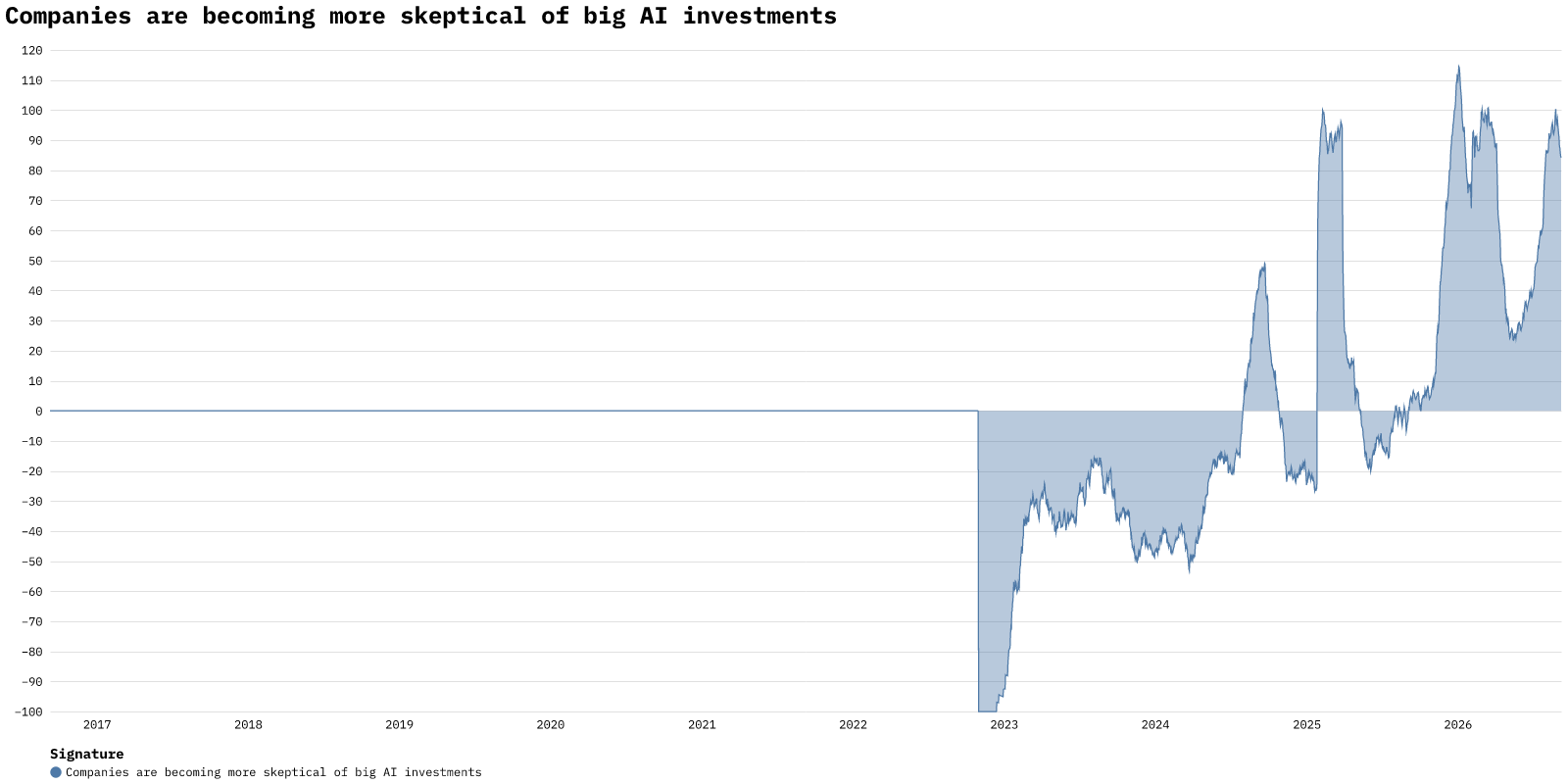
What did not fade is buyer scrutiny. Our signature tracking language asserting that businesses increasingly doubt large AI spending eased but remains elevated at 84.2, and the signature tracking language asserting that promised AI efficiency gains have not occurred, while down on the week, still reads 27.5, above average. Four independent 2026 surveys find that only 5% to 8% of enterprises report measurable, at-scale AI returns despite average annual spend of roughly $186 million, yet only 6% of executives say that they would actually cut spending if this year's initiatives underdeliver. The pattern is deferral, not cancellation: S&P Global found that 42% of companies abandoned most AI projects in 2025, up from 17% a year earlier, and Forrester expects enterprises to push 25% of planned AI spend into 2027, even as Gartner projects enterprise AI application spending to nearly triple to $270 billion in 2026. A separate Gartner survey found that just 22% of organizations have successfully scaled AI, yet 85% of functional leaders still plan to raise spending. One widely shared analysis framed the recent $890 billion tech drawdown as "the market's way of demanding an ROI conversation".
Our signature tracking claims that AI advances are translating into company profits rose to just below average, and the signature tracking language asserting AI will power a new bull market and strong US growth improved similarly. Bulls point to Anthropic's reported first operating profit in frontier AI as proof that "the capex is funded by demand, not hope", while skeptics counter that across 919 earnings calls at large US financial firms, only one company quantified a realized dollar return from AI.
 Source: Perscient
What thinned out this week were the long-horizon promises. The signature tracking language connecting AI to broad productivity gains and potential universal basic income posted the second-largest weekly decline in the set, falling to well below average, and the signature tracking predictions of a multi-decade investment supercycle also weakened. Our signature tracking language asserting the AI investment theme remains durable eased but stays elevated at 57.5, and the signature warning that non-adopters will be left behind was flat below average. The Magnificent 7 now represent roughly one-third of S&P 500 value, and the index sits at 23x forward earnings; the S&P 500 has averaged a 1.1% September decline since 1928, with megacap AI concentration cited as a possible amplifier. Watch whether the bubble signature's decline reverses into Q3 hyperscaler earnings.
Permission to Build Becomes the Competitive Frame — Local Backlash, Energy Nationalism, and a Reshuffled Leaderboard
Perscient's semantic signature tracking the density of language claiming opposition to large AI investments is increasing rose by 16.4 points to 97.9, the second-largest weekly increase in the set and one of the highest absolute readings outside the supply-constraint group. Our signature tracking language asserting that the country which builds the best energy infrastructure will determine AI leadership rose by 7.4 to 55.6.
 Source: Perscient
Mendocino County supervisors voted 5-0 on September 1 to adopt an urgency ordinance barring new data centers in unincorporated areas for 45 days, against a backdrop of more than 500 local bans and pauses across the U.S. as of mid-2026. The same day in Ohio, Miamisburg City Council voted 6-0 for a nine-month moratorium after community concern over a large-scale project at the former DP&L Hutchings Power Station site. At the state level, two pauses now define the picture: New York's Executive Order 62 covering DEC permits for facilities of 50 MW or more, and Texas's effective freeze on new grid connections while the PUC and ERCOT audit roughly 200 GW of interconnection requests, with September votes queued in Spartanburg County, Loudoun County, Lubbock and Pulaski County. Opposition is not winning uniformly: in early September, Indiantown's Village Council rejected a proposed hyperscale application pause 4-1, and North Port scheduled its moratorium vote for September 8, though local reporting notes that the North Port measure has already narrowed and faces legal questions. Brookings observes that citizen opposition cuts across state and party lines, and the most common worries are environmental impact, costs, and Big Tech siting facilities in residents' backyards.
The Diplomat argues that "Governments focusing mainly on semiconductor fabrication may be chasing past advantages instead of future ones," citing China's reported plan to invest roughly 2 trillion yuan, about $295 billion, over five years in a nationwide network of interconnected AI data centers. BloombergNEF estimates that China will add more than six times as much generation capacity as the U.S. over the next five years. This country-capacity framing is rising while claims of Chinese model leadership are not: our signature tracking assertions that DeepSeek or China leads the AI competition was flat.
 Source: Perscient
Our signature tracking assertions that Anthropic or Claude leads the AI race remains the strongest race-leadership reading at 164.9, consistent with third-party estimates placing Anthropic at roughly 40% of enterprise LLM API spend versus OpenAI's 27%. The signature tracking claims that Grok or xAI leads posted the largest weekly increase in the set, rising by 18.1 to 25.1, plausibly reflecting xAI's launch of Grok Bot for enterprises with new access, network and audit controls. OpenAI's leadership signature remains below average despite its September 2 Astra launch and claims of leapfrogging Anthropic, and Google's was flat. The signature tracking language claiming the eventual AI winner has not been founded yet ticked up modestly.
