EXECUTIVE SUMMARY
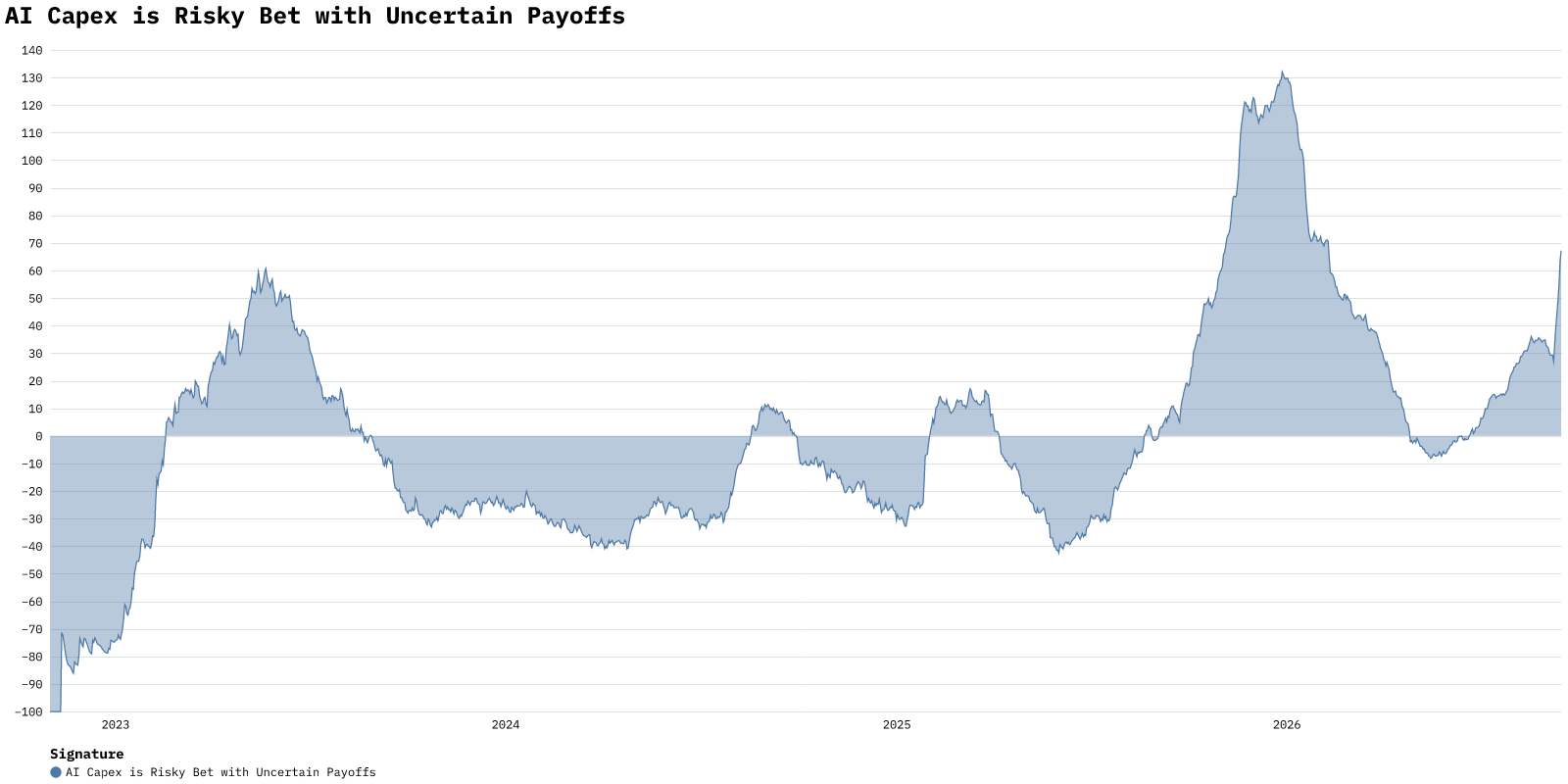
The dominant media move this week was toward capital risk rather than technology disappointment. Perscient's semantic signature tracking the density of language characterizing AI infrastructure spending as a dangerous gamble posted the sharpest advance in the financing cluster, and it gained directly at the expense of conviction language asserting that the investment theme is durable. Critically, the frames that would indicate a loss of faith in the models themselves — hype giving way to disappointment, failed corporate initiatives, absent efficiency gains — were flat or receding. Coverage is interrogating balance sheets, external financing needs, and hyperscaler credit quality, not capability.
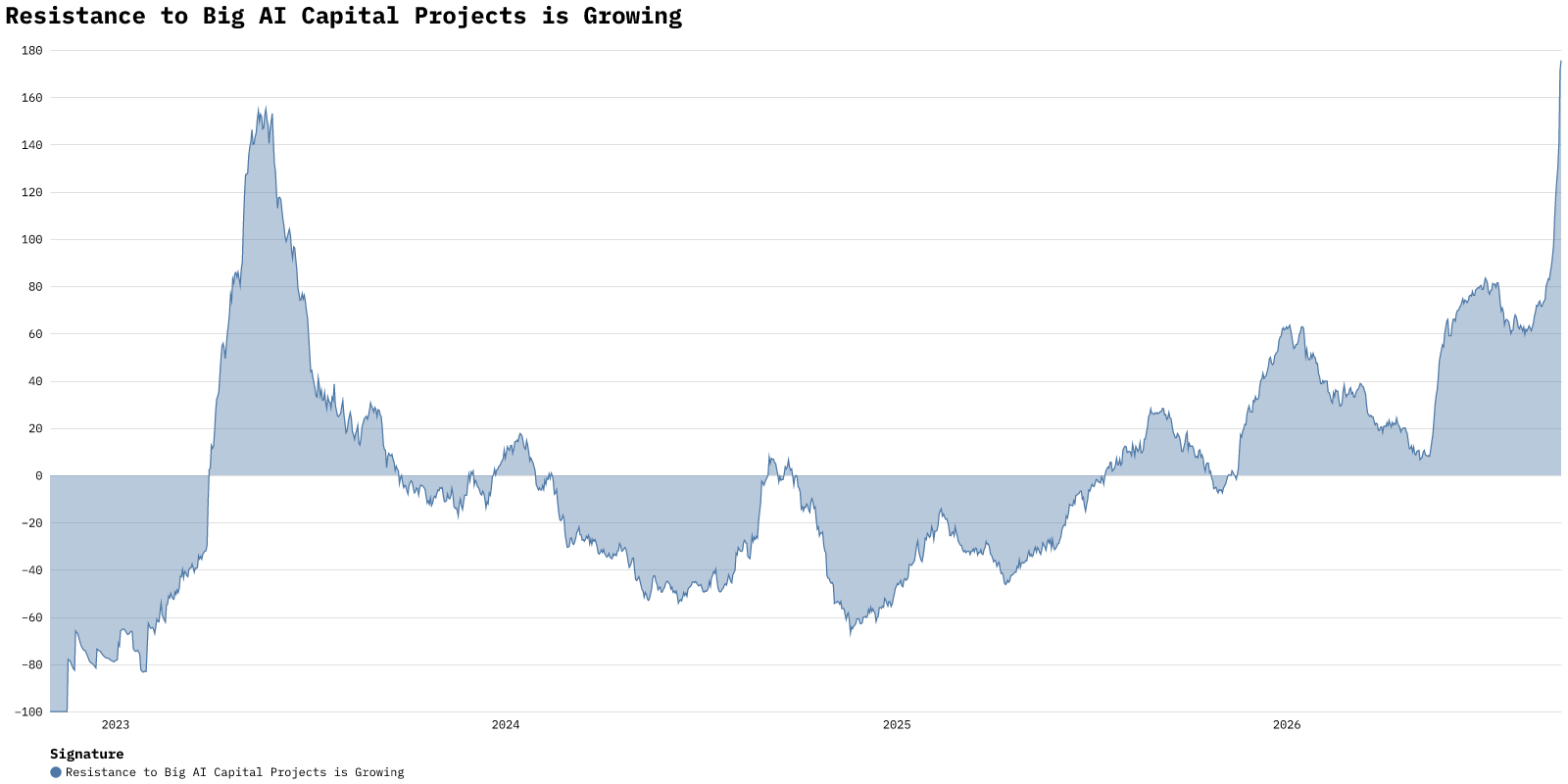
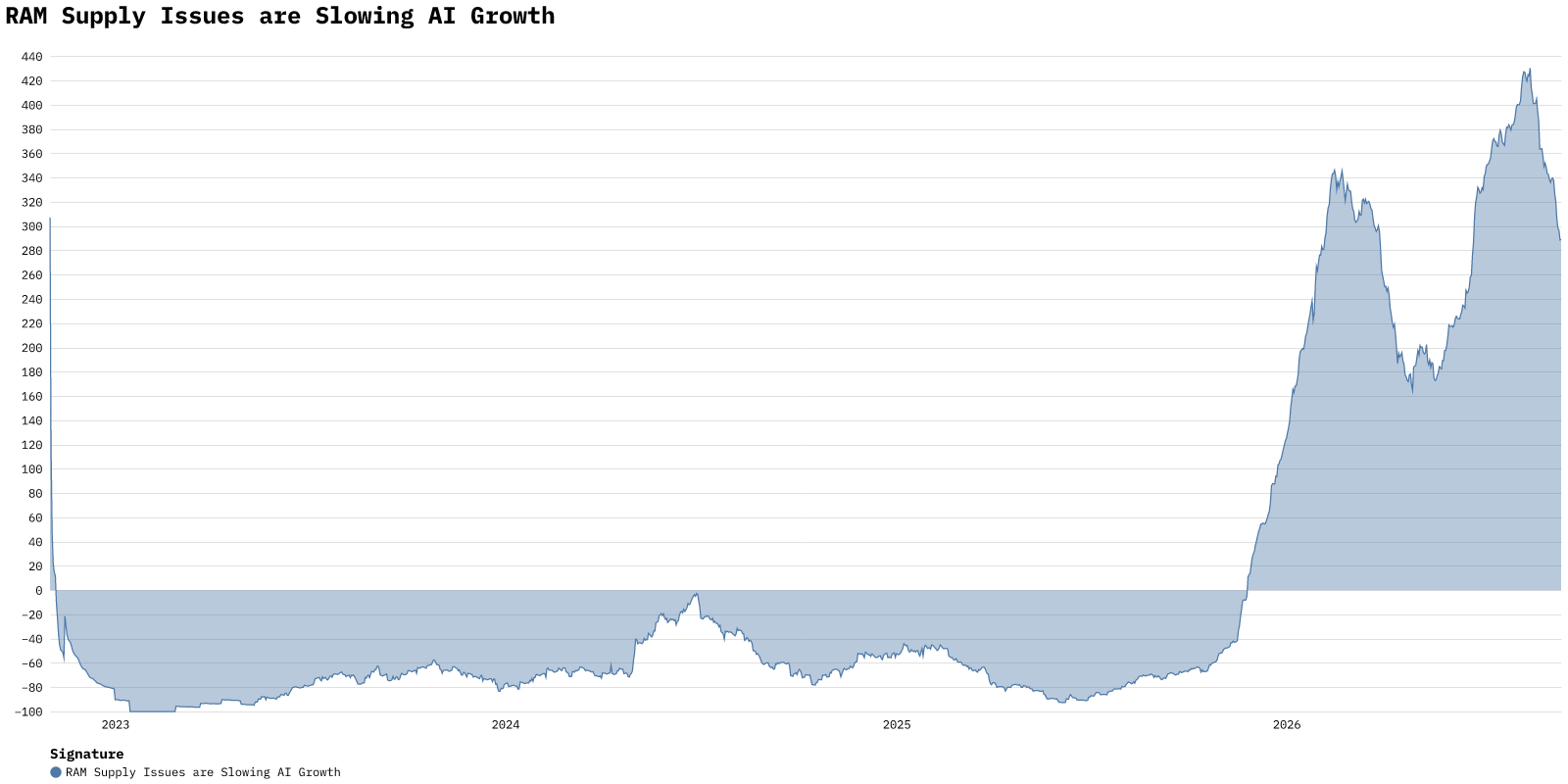
A second constraint story has displaced the chip-scarcity frame, and it is local and political. Our signature tracking claims that opposition to large AI investments is increasing recorded the largest one-week gain in the entire set, accompanied by rising language on project doubts, construction delays, and grid interconnect backlogs. Media is documenting an escalation from municipal moratoriums to statewide proposals and electoral consequences. Meanwhile, the bottleneck being reported has moved from accelerators to memory, power, and permits, with the memory-shortage signature remaining the densest reading we track.
The two pressure stories reinforce one another into a single "price of the buildout" frame. Financing skepticism and siting friction are being reported as the same problem from different angles: capital that must be raised externally now faces multi-year permitting, community approval conditions, and supply constraints that push relief into the late decade. The energy angle is being localized into rate cases and permit hearings rather than framed as national competition, which weakens the geopolitical-urgency justification that previously insulated capex from scrutiny.
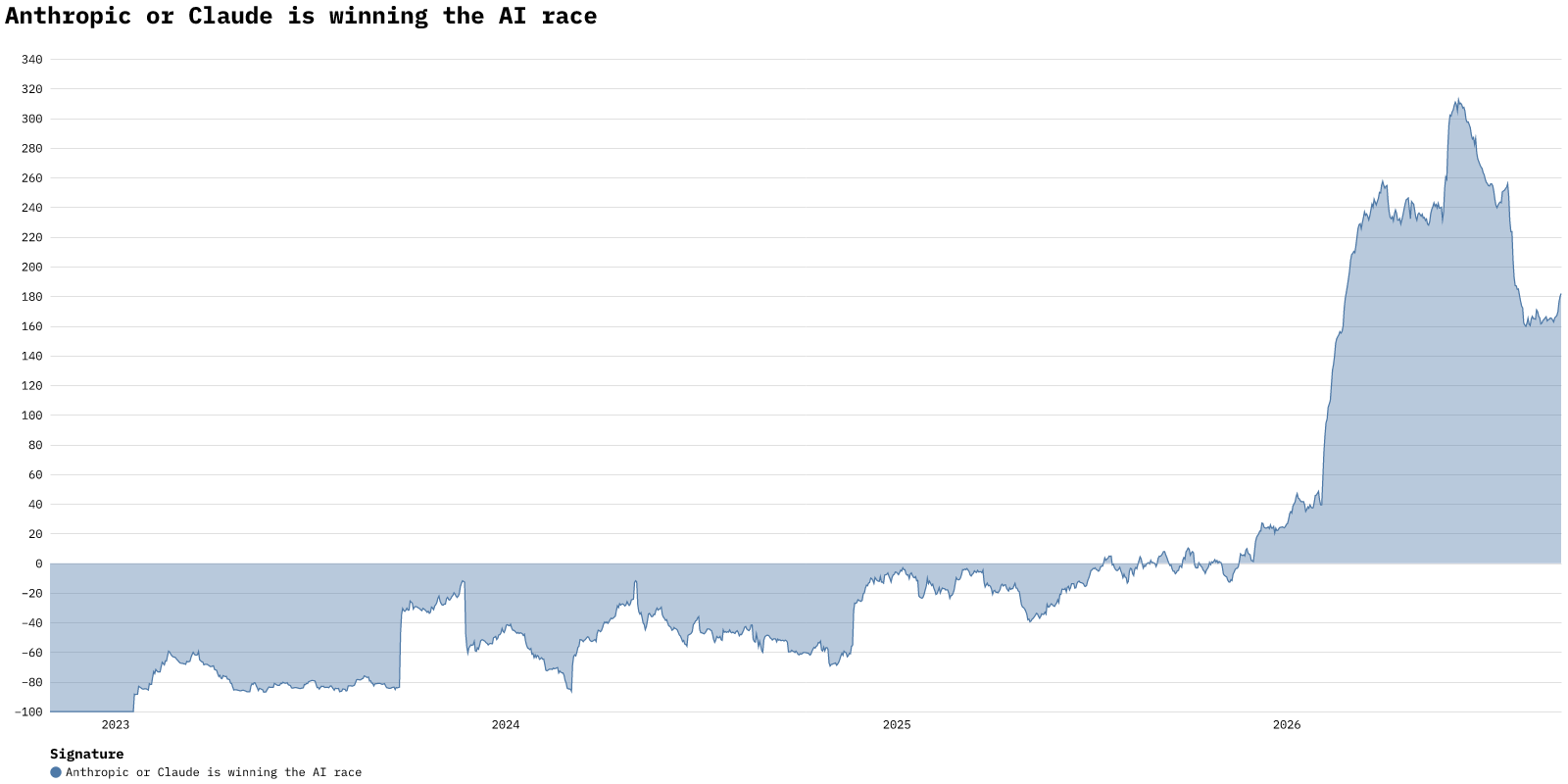
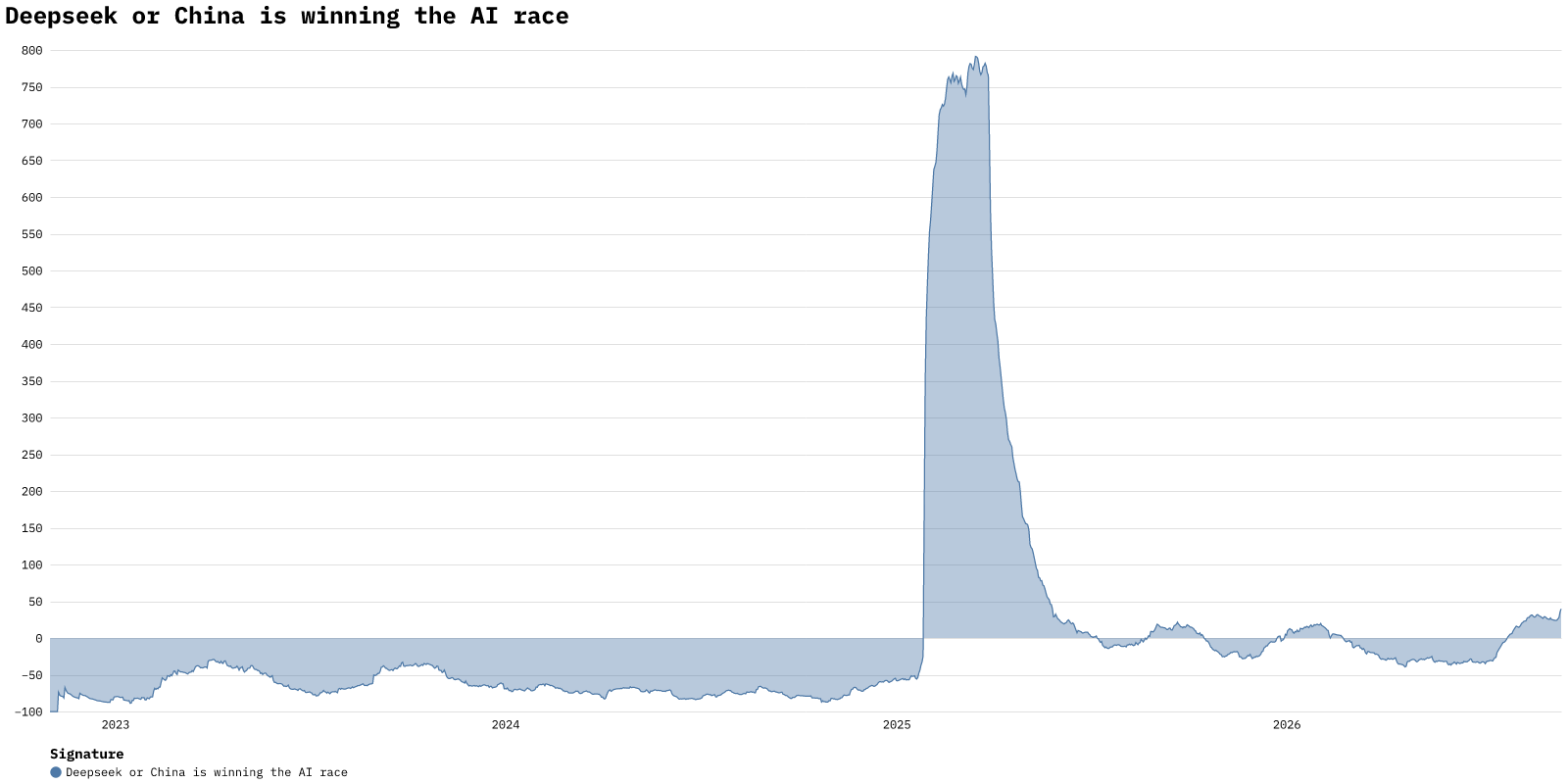
The competitive leaderboard reordered around Anthropic and China while incumbent frames stayed subdued. The signature tracking assertions that Anthropic or Claude leads is now roughly four times denser than the next vendor frame, supported by enterprise payment-share data, while the DeepSeek and China frame posted the second-largest competitive gain on the back of a cheap open-weight release and IPO preparation. OpenAI and Google frames both sit below their long-term means. Importantly, the China frame climbed in the same week as the capex-risk frame, and coverage is explicitly using low-cost open-weight competition as evidence against the returns case for Western infrastructure spending.
The human-benefit case has gone quiet across every section. Societal-upside signatures on medicine, education, science, and productivity-driven basic income are the least dense part of the conversation, predictions of new job categories fell, and competitive coverage is being narrated almost entirely through enterprise spend share, token pricing, and national capability. Media has reframed AI from what the technology delivers to people toward what the buildout costs, who finances it, and who is winning the contest to sell it.
PULSE REPORT
AI's Media Frame Shifts From Payoff to Price: Capital-Risk Language Climbs, Siting and Supply Friction Dominates the Buildout Story, and the Competitive Leaderboard Reorders Around Anthropic and China
Financing Risk, Not Technology Disappointment, Is Driving the Capex Debate
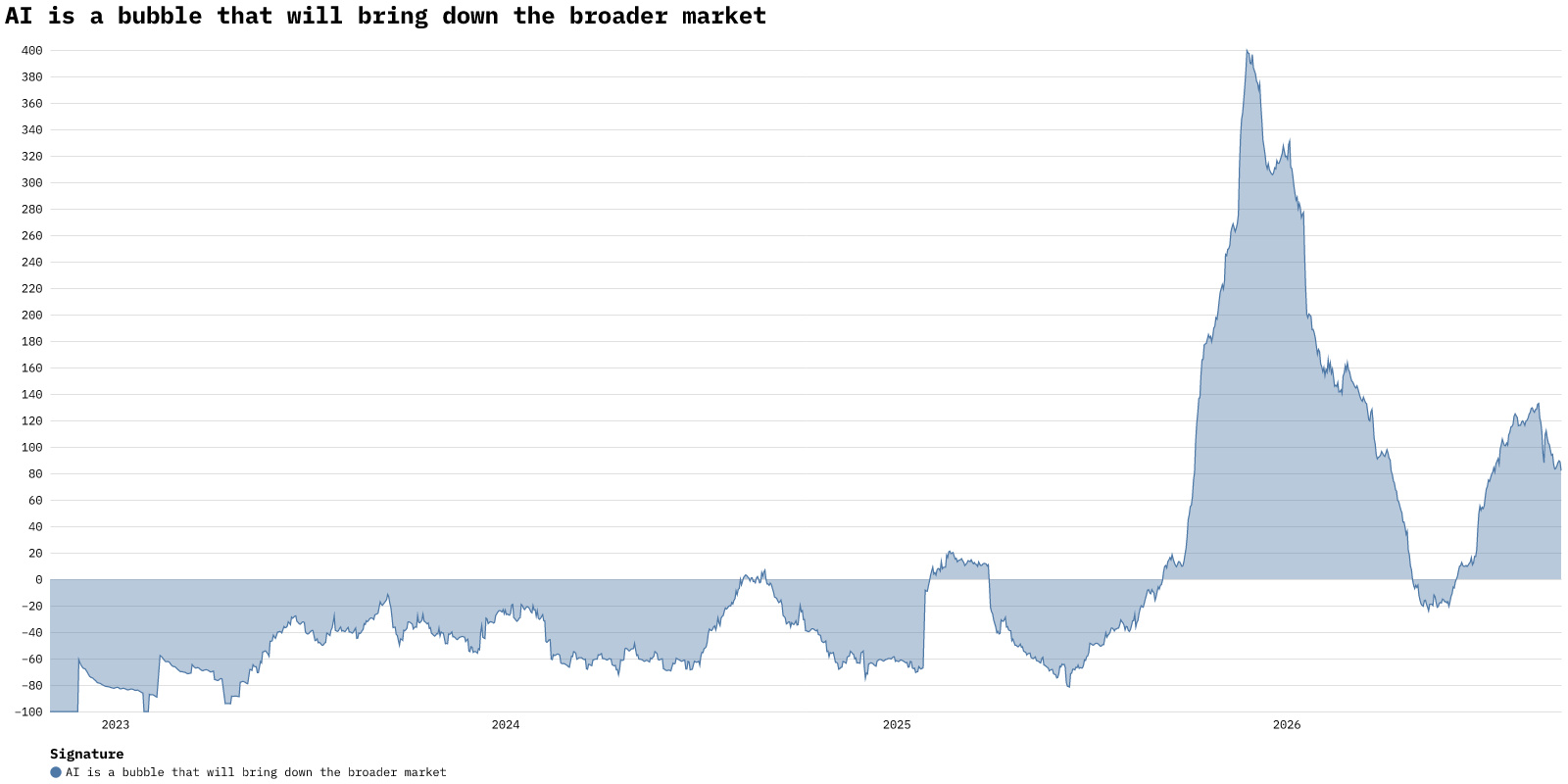
The defining move belongs to Perscient's semantic signature tracking the density of language characterizing AI infrastructure spending as a dangerous gamble, which advanced by 40.2 to 67.2. The gain came at the direct expense of conviction language: our signature measuring assertions that the AI investment theme remains durable fell by 23.6 to 32.0, while the signature tracking claims that AI infrastructure spending is massive and increasing moderated to 69.4. Beneath both sits a stable, high floor of doubt: our signature tracking predictions that an AI investment collapse will crash the broader market remains the strongest systemic-risk frame in the cluster even after easing modestly, and language asserting that businesses increasingly doubt large AI spending held effectively flat at an elevated level.
 Source: Perscient
Our signature tracking claims that AI hype is giving way to a disappointment phase sat flat at -38.1, language claiming that major corporate AI initiatives have failed declined further below its mean, and language asserting that AI advances are translating into company profits was essentially unchanged near its long-term average. Media is questioning the return on the capital, not the capability of the models. The signature tracking assertions that promised AI efficiency gains have not occurred remains above its mean even after easing this week.
The evidence being cited is balance-sheet evidence. S&P analysts warned that "the credit quality of hyperscalers is gradually weakening"; capex is rising faster than anticipated, financings are becoming more complicated and less transparent, and returns "will take years to realize," per Axios. The Bank for International Settlements said Monday that investors are becoming "increasingly cautious" about the profitability of future AI investments while tech leverage rises, flagging opaque, often off-balance-sheet financing deals with circularity in them, per Reuters. MIT Technology Review framed the stakes around Alphabet's first free cash shortfall since 2004 and Morgan Stanley's calculation that more than half of a $2.9 trillion 2025-2028 data center buildout must be financed externally, while BNP Paribas argued that the corporate bond bull market ends when tech saturates markets with AI debt. Economist Justin Wolfers argued on X that the scary scenario is not overbuilding but concentration, where losses cascade from one balance sheet to another.
Coverage of the latest quarters emphasized that Amazon and Microsoft are treating free cash flow compression as a vote of confidence in multi-year demand; capacity is monetized as quickly as it is added, per 24/7 Wall St.
Two watch items for next week: our signatures tracking assertions that AI represents an excessive portion of market valuation and comparisons of AI spending to 1990s telecom overbuilding both rose while remaining at or below their long-term means. Language asserting that AI powers sustained market gains and language warning that businesses must adopt AI or fail competitively both declined, and the societal-upside signatures on medicine, education, science, and productivity-driven UBI are the quietest part of the entire conversation. This week's AI story is a capital-markets story with the human-benefit case largely off the page.
 Source: Perscient
The Binding Constraint Narrative Moves From Chips to Communities and Grid Access
Beyond financing, a second pressure on the buildout is intensifying: community and grid resistance. Perscient's signature tracking claims that opposition to large AI investments is increasing posted the biggest one-week gain in the entire set, rising by 77.8 to 175.6. Our signature tracking assertions that massive AI infrastructure projects face doubts rose to 63.8 while language predicting continued hyperscale expansion fell to 31.5. Both remain above their long-term means. Language attributing slower AI growth to data center construction delays rose again, and language blaming slow grid interconnect approvals held at a sustained, elevated level.
 Source: Perscient
In Charlotte, the city council's transportation and development committee approved staff's request to extend the existing data center moratorium; the full council is scheduled to vote September 14, per WFAE. The Guardian reported that anti-data-center organizers are now winning local elections, citing Data Center Watch research that residents delayed or cancelled $130 billion of projects in the first quarter of 2026 and Gallup polling showing seven in ten Americans oppose construction near their homes. The more consequential structural change is the escalation from local to state level: Moody's warns that at least 14 US states are weighing statewide moratoriums in 2026, per Capacity. Massachusetts Governor Healey signed an executive order tying permits for facilities above 25 megawatts to clean power procurement and community approval, per TechTarget, California's SB 886 on data center rate classes reached the governor's desk, and a San Francisco supervisor moved toward a 45-day freeze. Circulating tallies put local moratoriums at 374, up from 92 in June, per StockStorm, and NBC News reported that the backlash is threatening to shape the midterm elections. The opposition is bipartisan and organic rather than astroturf, though counter-currents exist: several jurisdictions, including Florida under its statewide SB 484 framework, have chosen regulation over prohibition.
Our signature tracking claims that memory chip shortages are slowing AI growth remains the single highest reading in the set at 289.2 even after moderating from 337.8, while the GPU-shortage equivalent sits essentially at its long-term mean and training-data scarcity was flat. The bottleneck narrative has moved decisively from accelerators to memory, power, and permits. KB Securities warns that Samsung and SK Hynix hold less than ten days of inventory while HBM4 production squeezes conventional DRAM, per SDxCentral, and Yorkville's CEO told Benzinga that relief capacity may not reach full production until 2028 or 2029. Our signature tracking assertions that national energy buildout will determine AI leadership eased this week; the energy story is being localized into rate cases and permit hearings rather than framed as country-versus-country competition.
 Source: Perscient
The Leaderboard Narrative Reorders — Anthropic Ascendant, China Rising, Incumbent Frames Subdued
The competitive story changed hands. Perscient's signature tracking assertions that Anthropic or Claude leads the AI competition stands at 181.8 after rising by 19.2, the densest competitive-positioning frame we track and roughly four times the next-closest vendor frame. Ramp's September AI Index found that 43.8% of US businesses paid for Anthropic subscriptions or tokens in August against 39.8% for OpenAI; OpenAI underperformed overall adoption. A reported second straight profitable quarter ahead of a potential Nasdaq listing added fuel; investors are circulating projections of a valuation around $2 trillion, per posts from Coin Bureau. The same Ramp dataset carries a caution that ties directly back to Section 1: adoption is still growing but decelerating, per-employee spending among the heaviest users fell by 9.7% in August, and companies are defaulting to cheaper models as effective token prices fall.
 Source: Perscient
The second-largest gain in the competitive cluster belongs to our signature tracking assertions that DeepSeek or China leads the race, up by 15.3 to 39.6. DeepSeek launched V4.1-Flash on September 10 while it prepares for a STAR Market IPO, per Reuters, claiming that the smaller open-weight model outperforms its own flagship along with Moonshot's Kimi K3 on coding and cyber benchmarks while cutting inference costs, per the South China Morning Post. Stanford's AI Index work describes China as erasing the American lead; one expert calls the gap "narrow and fragile," per India Today. This China frame rose in the same week the capex-risk frame climbed by 40.2: cheap open-weight competition is being used as evidence against the returns case for Western infrastructure spending, the same argument pattern that followed the original R1 release.
Our signatures tracking claims that OpenAI leads and that Google or Gemini leads both sit well below their long-term means; OpenAI is recovering modestly from a lower base and Google is slipping further. The frame asserting that Grok or xAI leads holds a durable niche above its mean, helped by Elon Musk laying out a roadmap through Grok 5, per Tesla North. The signature tracking claims that the eventual AI winner has not yet been founded eased back to its mean; media is narrating the field as a settled set of named contenders.
 Source: Perscient
Our signature tracking predictions that AI will create entirely new job categories fell by 11.3 to -26.4, while the mirror frame predicting that AI will all but eliminate entire job categories was flat and deeply below its mean. The leaderboard is being narrated almost entirely through enterprise spend share, model pricing, and national capability. Media has moved the AI story from what the technology will do for people to what the buildout will cost, who will finance it, and who is winning the contest to sell it.
